
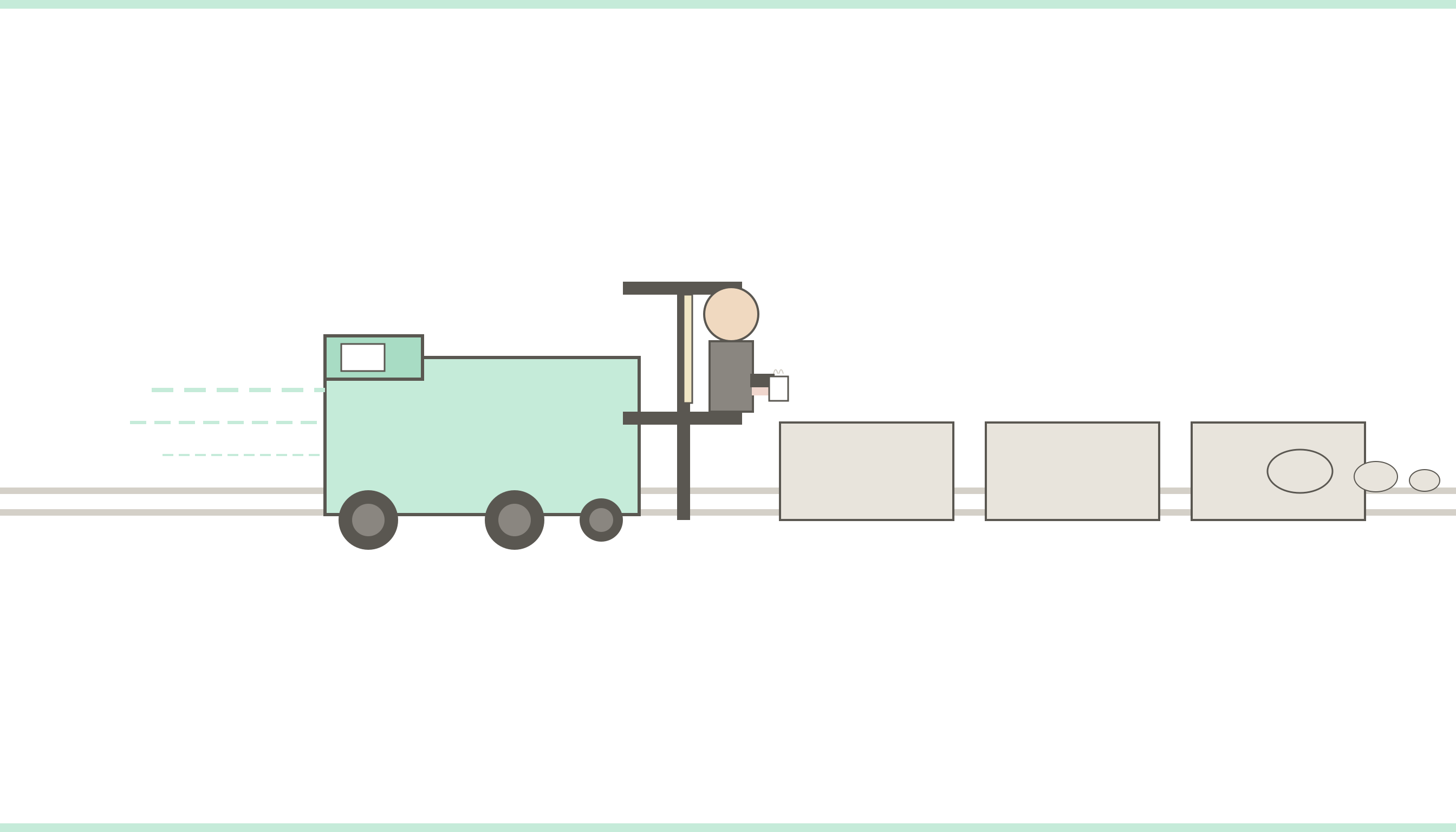
Six months into your company-wide AI coding rollout, the dashboard looks good in one place and terrible everywhere else. PRs merged per engineer climbed sharply, exactly as advertised. Then you look at lead time. It went up. Deployment frequency is flat. Incidents per PR have more than doubled.[1]
This is not a tooling problem. It's an Amdahl's Law problem.
Amdahl's Law, from 1967, says the overall speedup of a parallel system is bounded by the fraction you can't improve. Applied to software delivery: if coding is roughly 20% of your end-to-end lead time and you make it infinitely fast, lead time drops by at most 20%.[2] The other 80% — review, testing, CI queue, approval gates, staging, deployment verification — stays exactly where it was. Except now it's absorbing three times the volume.
AI coding tools optimized the cheap part of software delivery. The productivity paradox follows from that fact mechanically. Teams using AI heavily see AI-generated PRs wait for review 4.6 times longer than human-written ones.[3] Median time to first PR review is up 156.6% across high-adoption teams. Median total time in PR review is up 441.5%.[1]
The coding speed win is real. The delivery pipeline doesn't care.
Key Takeaways
- ✓
Coding is ~20% of lead time. AI tools optimized the 20% and left the 80% structurally unchanged — the bottleneck didn't move, it just got more pressure.
- ✓
AI-generated PRs wait 4.6× longer for first review than human-written code (Opsera 2026 benchmark). Review capacity wasn't sized for machine-paced output.
- ✓
The fix is structural: small PR mandates, automated pre-review gates, parallel CI test shards, and tiered approval policies are the four levers that convert coding speed into shipping speed.
- ✓
Only 6% of CD processes are fully automated (Harness 2026). That number explains why your deployment frequency hasn't moved.
The Metrics That Look Like Progress Aren't
PR volume and individual throughput went up. Everything downstream went sideways.
Post-rollout, the metrics leadership tracks — story points completed, PRs merged, features shipped to staging — all show the line moving up-right. So the board meeting goes well.
Then senior engineers start burning out. Incident rates climb. The CFO asks why lead time increased despite the AI tools budget. The answer is in the data, if you look at the right data.
Faros AI tracked over 10,000 developers across 1,255 teams through 2025 and found that under high AI adoption, bugs per developer rose 54%, monthly incidents climbed 57.9%, and average task wait time — queued and blocked, not actively progressing — rose 81.8%.[1] Tasks didn't move faster. They stacked up in different places.
The mechanism is simple. Before AI, your engineering system had two working assumptions baked in: roughly bounded code volume per engineer per week, and roughly consistent code quality from that volume. Review queues, CI runner capacity, QA cycles, on-call rotation size — all sized for those assumptions. AI broke both simultaneously. Volume per engineer roughly doubled. Quality became inconsistent in ways that surface-level review doesn't catch reliably, because AI-generated code is often stylistically convincing while containing structural problems that require careful reading to find.[1]
A system designed for human-paced output is now absorbing machine-paced output. That's a capacity and architecture problem, not a cultural one.
AI-generated PRs wait 4.6× longer for first review than human-written PRs — Opsera 2026 benchmark
Median total time in PR review across high-AI-adoption teams — Faros AI 2025
Bug rate increase under high AI adoption; surface quality up, structural correctness inconsistent — Faros AI 2025
Share of engineering orgs with fully automated continuous delivery — the rest gate on manual approvals — Harness 2026
Where Your Speed Went
Four stages consumed the gains. Each has a different failure mode and a different fix.
The review queue is the dominant bottleneck for most teams, and it compounds. When every engineer submits 2–3× the PRs, reviewers receive 2–3× the volume. But AI-generated code takes longer to review — not because reviewers are slow, but because the work is harder. The code compiles. The tests pass. The naming is idiomatic. The structural problems — wrong abstraction, missing edge case, implicit dependency on shared state — sit underneath the surface, requiring careful reasoning from engineers with enough context to know what's missing. One mid-market engineering org tracked average PR age rising from 1.2 days to 4.7 days after rolling out AI assistants company-wide.[4] That's not slow reviewers. That's a queue sized for a world that no longer exists.
CI throughput is the second bottleneck. Test suites that ran without issue at human velocity start showing age when PR volume doubles. Flaky tests, which were an annoyance before, become a crisis — they now trigger on twice as many PRs per day. Build queues that cleared in 20 minutes now take 45. If CI feedback takes more than 15 minutes, engineers are no longer in the same mental context when results come back. That context switch is a throughput tax paid by every engineer on every PR.[2]
Deployment approval gates are the third. Most were designed when deploying was consequential and relatively rare, so they required synchronous sign-off from a senior engineer or release manager. That design assumption no longer holds. With higher PR volume, more features sit code-complete behind a gate that runs on a Tuesday-Thursday release train. The gate didn't change. The backlog behind it did.
Test suite maintenance is the fourth, and the sneakiest. AI makes generating tests fast. It doesn't generate tests that fail correctly. Teams running high AI adoption often see passing test suites while incident rates climb — the tests pass but miss the failures that matter.[6] When you generate tests for generated code without reviewing both independently, you get a confidence signal that isn't anchored to correctness.
The Review Queue Fix Is Not More Reviewers
Adding reviewers scales coordination cost linearly and still loses to volume. The fix is changing what enters the queue.
When review backs up, the instinct is to assign more reviewers. That's the wrong lever. More reviewers means more coordination overhead, more inconsistent standards, and more senior engineer time pulled into work that automated tooling should filter first. The queue is a quality-of-input problem, not a staffing problem.
Three changes restructure review into a filter rather than a backup:
Small PR mandate. AI makes it easy to generate large changesets. That's the wrong direction. PR size is one of the most reliable predictors of review quality and defect escape rate — the correlation shows up across independent code quality studies.[5] Cap AI-generated changes at 200–300 LOC per PR. Enforce it with a CI check, not a cultural ask. When a PR exceeds the limit, the check fails and the author splits it. AI tools decompose a large changeset into logical chunks faster than a human reviewer can finish reading the original.
Automated pre-review. Static analysis, type checking, security scanning, and test coverage checks should run before any human looks at the code. If 40% of review comments on AI-generated PRs are catching things a linter or type checker could catch, that's 40% of reviewer capacity spent on machine-detectable work. The goal is to make the human review step purely about correctness and intent.
CODEOWNERS-based auto-assignment. Route PRs to engineers based on file ownership, not reviewer availability. The engineer who owns the payments module should review payments changes — not whoever has the shortest review queue that morning. Ownership-based reviewers have the context to catch structural problems that pass a surface reading. This is the only reliable counter to AI-generated code that looks correct but isn't.
CODEOWNERS# Auto-assign reviewers by code ownership
# https://docs.github.com/en/repositories/managing-your-repositorys-settings-and-features/customizing-your-repository/about-code-owners
# Default: core team reviews anything not explicitly claimed
* @your-org/core-team
# Auth module — auth team must review, no exceptions
/src/auth/ @your-org/auth-team
# Payments — two reviewers required (domain + security)
/src/payments/ @your-org/payments-team @your-org/security-team
# CI and infra config — platform team gates all changes
/.github/ @your-org/platform-team
/terraform/ @your-org/platform-team
# Data models and migrations
/src/models/ @your-org/data-team
/migrations/ @your-org/data-team
# API contracts — breaking changes need API team sign-off
/src/api/ @your-org/api-teamCI Has a Feedback Time Budget. Enforce It.
15 minutes is the ceiling. Past that, you are managing a flow-state problem, not a testing problem.
Test suites that ran fine at pre-AI volume become the hard ceiling on shipping speed post-AI. If your suite takes 35 minutes, engineers context-switch out and stop waiting. That's not a discipline problem — it's what humans do when feedback is too slow to hold in context.
The targets: build and lint under 5 minutes for a standard PR, full test suite under 10 minutes. Over 15 minutes, engineers move to something else. Over 20, the CI pipeline is actively degrading team throughput — every engineer on every PR is paying the context-switch tax.
GitHub Actions matrix strategy is the fastest path to parallelized test execution. Instead of running all test files sequentially, you split them across N shards. At 4 shards, a 40-minute test suite becomes 10 minutes. At 8 shards, 5 minutes. The cost is runner minutes; the benefit is preserved feedback loops and lower review queue depth — because reviewers don't wait on CI results before they know it's safe to merge.
One real constraint: parallelizing a flaky test suite amplifies the flakiness problem significantly. With 5% flaky tests at 1× volume, you expect occasional false failures. At 8× parallelism, you get near-certain CI failures on every run. Fix flakiness before sharding, not after. The audit is worth the week it takes.
.github/workflows/ci.ymlname: CI
on:
pull_request:
branches: [main]
jobs:
# Fast pre-flight — runs before test suite, blocks on lint/type errors
pre-review:
name: Pre-Review Gates
runs-on: ubuntu-latest
steps:
- uses: actions/checkout@v4
- uses: actions/setup-node@v4
with:
node-version: '20'
cache: 'npm'
- run: npm ci --prefer-offline
- run: npm run lint
- run: npm run typecheck
# Reject PRs that exceed 300 LOC — split AI-generated large changesets
- name: PR size gate
env:
BASE_SHA: ${{ github.event.pull_request.base.sha }}
run: |
INSERTIONS=$(git diff --stat "$BASE_SHA" | tail -1 | grep -oP '\d+(?= insertion)' || echo 0)
if [ "$INSERTIONS" -gt 300 ]; then
echo "PR exceeds 300-line limit (${INSERTIONS} insertions). Split into smaller changes."
exit 1
fi
# Parallel test shards — 4 workers cut a 40-min suite to ~10 min
test:
name: Tests (${{ matrix.shard }}/${{ matrix.total }})
runs-on: ubuntu-latest
needs: pre-review
strategy:
fail-fast: false
matrix:
shard: [1, 2, 3, 4]
total: [4]
steps:
- uses: actions/checkout@v4
- uses: actions/setup-node@v4
with:
node-version: '20'
cache: 'npm'
- run: npm ci --prefer-offline
- run: npx jest --shard=${{ matrix.shard }}/${{ matrix.total }} --ci --forceExit
# Security scan — parallel with tests, not blocking review queue
security:
name: Security Scan
runs-on: ubuntu-latest
needs: pre-review
steps:
- uses: actions/checkout@v4
- uses: aquasecurity/trivy-action@master
with:
scan-type: fs
severity: HIGH,CRITICAL
exit-code: '1'Approval Gates Were Designed for Rare Deployments. Retire That Design.
When deploys happened weekly, synchronous sign-off made sense. Daily deployment needs tiered risk, not uniform friction.
Most approval gates were established when deploying was consequential and relatively uncommon. An engineering lead signs off before production. A change-control ticket gets filed. A deployment window opens Tuesday and Thursday mornings. Those conventions existed because when deployments required manual coordination and rollback scripts, the cost of a failed one justified the friction.
Under AI-assisted development, the target is daily or multiple-daily deployment. Release cadence is the feedback mechanism — you don't know if code works until it's under real production load. The longer code sits in staging waiting for a synchronous approval, the longer the feedback gap and the higher the blast radius when something is wrong.
The redesign tiers approval requirements to match risk, not frequency:
Auto-approve on merge for low-risk changes: test coverage above threshold, no schema changes, no auth or billing changes, no infrastructure modifications. Clean CI plus a scoped diff is sufficient signal. If something breaks, rollback runs in minutes.
Single synchronous review for medium-risk: schema changes, new external dependencies, significant scope expansion. Assigned via CODEOWNERS — the engineer who owns the affected code, not a release manager.
Full gate for high-risk: auth changes, data migrations, external service integrations. Requires review, QA sign-off, and an explicit check that incident response capacity is available before the deploy window opens.
This is not removing oversight. It's concentrating oversight where the risk is real and removing it where it was theater.
Every PR requires senior engineer sign-off regardless of risk
Deployment windows: Tuesday and Thursday only
Manual security review for every deploy
Change-control ticket required for all merges
Reviewer assigned by availability, not ownership
Low-risk changes auto-approve on clean CI
Deploy on merge for non-schema, non-auth changes
Automated security scan in CI — humans review flagged results only
No ticket for standard changes; CODEOWNERS routes automatically
Domain-expert reviewer assigned via CODEOWNERS, every time
Measuring Whether the Fix Is Working
These are the numbers that tell you if pipeline restructuring is landing — not developer throughput metrics.
| Stage | Metric | Pre-AI Baseline | Post-AI Target | Danger Signal |
|---|---|---|---|---|
| Code Review | Time to first review | 4–8 hours | < 2 hours |
|
| Code Review | Total PR cycle time | 1–2 days | < 4 hours |
|
| Code Review | Review cycles per PR | 1.2 avg | < 1.5 |
|
| CI Pipeline | Build + lint runtime | 8–12 min | < 5 min |
|
| CI Pipeline | Full test suite runtime | 20–40 min | < 10 min |
|
| Deployment | Merge to production | Hours to days | < 1 hour |
|
| Quality | Change failure rate | 5–10% | < 5% |
|
| Quality | Incident rate per PR | Baseline | < 1.2× baseline |
|
Pipeline Restructuring Checklist
CODEOWNERS file covers all critical paths — no PR routes to 'whoever is available'
CI pre-review runs lint, typecheck, and security scan before any human reviews
PR size gate enforced in CI — > 300 LOC fails the build
Test suite sharded to 4+ parallel workers — total runtime under 10 minutes
Flaky tests audited and fixed before parallelization is enabled
Deployment approval tiers documented and enforced in pipeline config, not cultural expectations
Change failure rate tracked separately from throughput metrics
Deployment frequency target set — daily minimum for non-regulated services
Common Questions
What teams run into when the velocity problem turns out to be structural.
We already have automated tests — why is quality still dropping?
Generated tests for generated code create circular validation. If the same model wrote the implementation and the tests, both can share the same misunderstanding of what the code should do. Test quality is not the same as test coverage. Audit for tests that never fail across any branch — they are not testing anything. Require independent human review on test changes for any path touching critical flows: payments, auth, data integrity.
Our reviewers are overloaded. Won't adding constraints slow them down more?
Small PRs review faster, not slower. A 150-line PR takes an experienced reviewer 15–20 minutes and catches problems per line at high rates. A 600-line PR takes 60–90 minutes and catches fewer issues proportionally. The workload doesn't increase — it shifts from long undifferentiated review blocks to shorter, more focused sessions. The first two weeks feel like more overhead; then the queue drains and senior reviewers recover hours per week.
How do we handle PRs that legitimately need to be large?
Large PRs are almost always a design problem, not a scope problem. A 500-line change is usually separable into a refactor PR (no behavior change), a data model PR, and a feature PR. AI tools are good at this decomposition — prompt the agent to split before submitting. Exceptions do exist: library upgrades, auto-generated migrations. Exempt those categories explicitly in your CI check by path or label, and don't create a blanket override that swallows everything.
We're in a regulated industry. Can tiered approvals survive an audit?
Tiered approval is more audit-friendly than uniform manual sign-off, not less. When every deploy goes through the same gate regardless of risk, auditors can't distinguish a minor bug fix from a data migration. When you document risk tiers, automate routing, and log what automated checks ran, you produce a traceable record of what changed, which tier it entered, who approved it, and what gates it cleared. That record is what compliance audits actually want to see.
The pipeline problem is structural, not cultural. Asking reviewers to move faster, encouraging engineers to write smaller PRs out of habit, or pressuring leads to approve faster — none of those produce changes that hold past the next sprint.
The structural version has four parts: a CODEOWNERS file that routes automatically, a CI check that enforces size limits, a shard configuration that keeps test feedback under 10 minutes, and a tiered approval policy that lives in pipeline config rather than a process doc. Each is independently reversible. Each produces a measurable signal within days of deployment.
AI made code generation cheap. The constraint moved to wherever humans are still in the loop without decision support — review, testing, and approval. None of those were designed for machine-paced input. The teams that convert coding speed into shipping speed are the ones that redesign the 80% instead of celebrating the 20%.
- [1]Faros AI — AI is making engineers faster. So why does delivery feel slower?(faros.ai)↩
- [2]App Vitals — Why AI Coding Tools Don't Make Teams Ship Faster (And What Does)(app-vitals.com)↩
- [3]Opsera — AI Coding Impact 2026 Benchmark Report(ajoconnell.com)↩
- [4]Wawandco — The AI Velocity Paradox: Why Your Team Ships Slower When Developers Move Faster(wawand.co)↩
- [5]Faros AI — DORA Report 2025 Key Takeaways: AI Impact on Dev Metrics(faros.ai)↩
- [6]Appetizers.io — AI-Assisted Engineering: The Productivity Paradox Nobody Warns You About(appetizers.io)↩
- [7]Network Perspective — When AI Makes Coding Fast, Delivery Gets Slow(networkperspective.io)↩
- [8]Harness Report: AI Coding Accelerates Development, DevOps Maturity in 2026 Isn't Keeping Pace(prnewswire.com)↩
- [9]Harness Report Reveals AI Velocity Paradox: Productivity Gains Undone by Downstream Bottlenecks(prnewswire.com)↩