All pieces
Strategy & Operating Model
PM Ratios for Agentic Teams: Why Product Definition Is the New Bottleneck
Agentic tools push engineering past 2–3x velocity and product definition becomes the binding constraint. Hiring more PMs makes it worse. The fix is a three-tier decision rights model that moves authority to where the information actually lives.
Engineering can ship. The question is whether product can feed it.
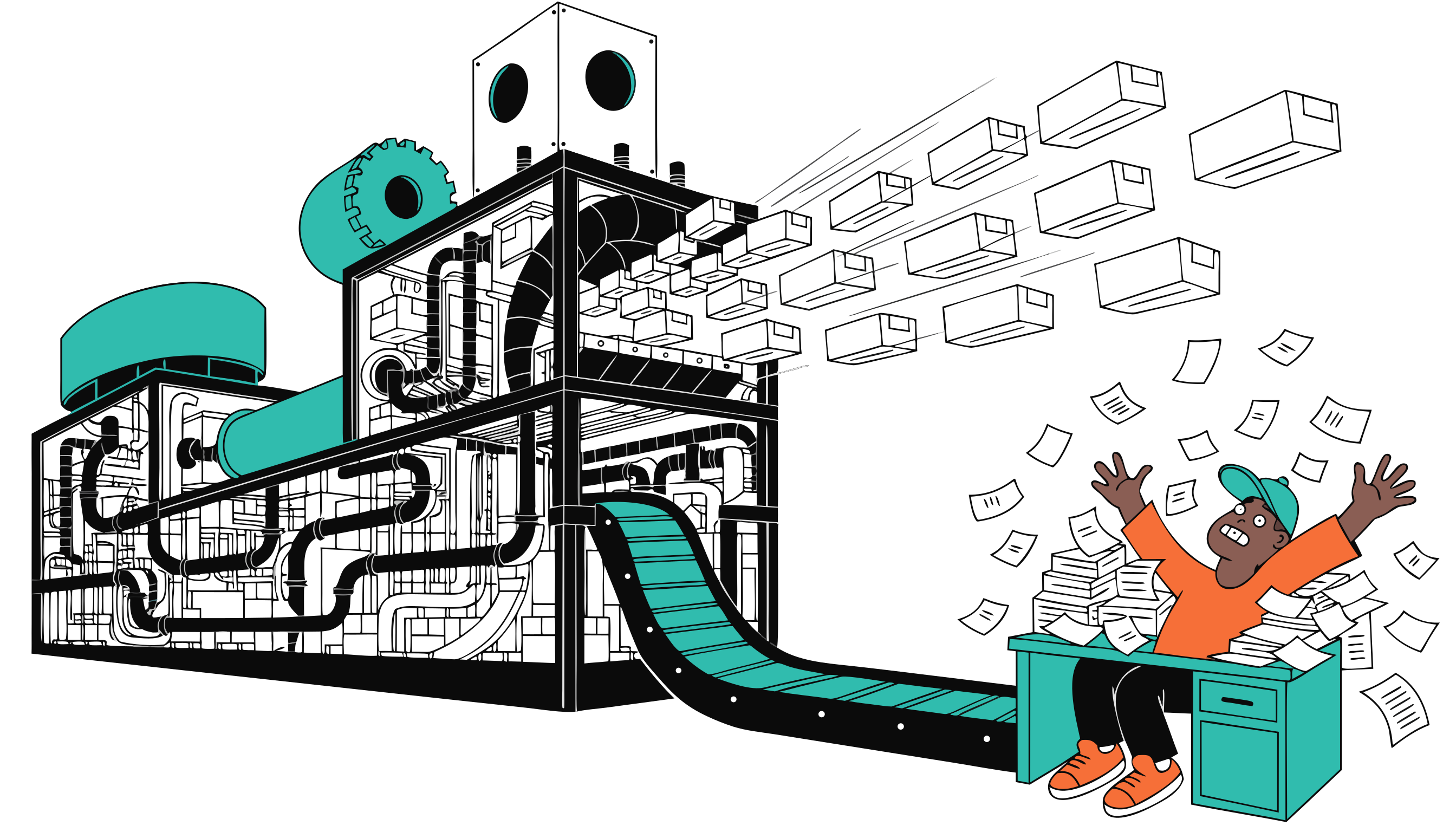

Forty engineers, one PM, two designers. That is the actual headcount on OpenAI's Codex team, documented by Gergely Orosz in the Pragmatic Engineer.[2] Most engineering leaders hit that number and reach for the same dismissal: exceptional talent, special circumstances, doesn't generalize.
Wrong question.
The interesting question isn't whether 40:1 ports to your org. It's why teams that respond to a PM bottleneck by hiring more PMs end up slower, not faster. Andrew Ng watched the traditional 6:1 ratio compress in real time on his own teams — six engineers per PM, then four, then two, then one-to-one — and then watched teams propose one PM for every half an engineer.[3] The diagnosis is correct: engineering is no longer the constraint, deciding what to build is. The reflex fix — more PMs, deputize product-minded engineers — doesn't touch the structural cause.
The structural cause is misallocated decision authority. PMs hold the call on decisions where engineers carry more context. Engineers wait on permission for decisions they should be making alone. Adding people to that topology doesn't fix it. It adds more people navigating the same confusion at a higher coordination tax.
40:1
OpenAI Codex engineer-to-PM ratio
Forty engineers, one PM, two designers — documented by Gergely Orosz, Pragmatic Engineer 2026.
55%
Faster task completion with AI coding tools
GitHub/Accenture enterprise study: developers using Copilot completed JavaScript tasks 55% faster than those without. PR cycle time dropped from 9.6 days to 2.4 days.[7]
40%
PM productivity gain from AI — against a 55% engineering gain
McKinsey studied 40 PMs across discovery, viability, and build phases. AI lifted PM output 40% — real, but engineering gains outpace it.[8]
What you'll get from this article
- ✓
Why the PM bottleneck is structural, not a headcount problem
- ✓
A three-tier decision rights model with specific ownership for each tier
- ✓
A decision matrix for classifying any product call into the right tier
- ✓
A concrete four-step implementation plan for restructuring authority
- ✓
Warning signs the restructure is failing — and what to do about each
- ✓
An authority transfer checklist your team can use Monday morning
The Bottleneck Was Always Product. Engineering Was Hiding It.
Resolve one constraint and the next one surfaces. Product definition is what surfaced.
Engineering velocity was the dominant constraint for most of the last decade. Build cycles took weeks. Sprints felt perpetually behind. PMs kept the backlog deep because engineering needed the buffer — without it, engineers stalled between batches of well-defined work.
Agentic coding tools compressed that buffer hard. GitHub's study with Accenture across 4,800 developers found PR cycle time dropped from 9.6 days to 2.4 days — a 75% reduction.[7] Successful builds increased 84%. Code generation quality improved enough that review friction dropped with volume. Teams running Claude Code, GitHub Copilot in agent mode, or Cursor with autonomous features routinely report 2–3x velocity on individual tasks.[4] Test generation, boilerplate, and documentation move even faster. The backlog that took a quarter to clear now ships in weeks.
This is not a new problem appearing. It's an old problem that engineering throughput was masking. Product definition was always the constraint. Deciding which problem to solve, for whom, to what fidelity, in what order — that work was never fast. It didn't matter how slow it was when engineering was slower.
Now it matters. McKinsey's study of 40 PMs across the full product lifecycle — discovery, viability, build — found AI lifted PM output by 40%.[8] That sounds good until you put it next to the 55% task speed gains on the engineering side and the 75% PR cycle time reduction. The gap is widening, not closing. The factory floor runs faster than the design room can feed it. And the standard response — add more designers — misses why the design room is slow.
Why Hiring More PMs Makes the PM Bottleneck Worse
Coordination cost scales with headcount. Output does not.
The instinctive fix is more headcount. If the ratio is 1:8 and engineering doubled throughput, hire to 1:4. Some organizations are running exactly that play. Anthropic, per 2025 reports, is both hiring more PMs and deputizing product-minded engineers to act as mini-PMs on projects under two weeks.[3]
It buys time. It doesn't fix the structure.
More PMs don't speed up product decisions. They multiply the number of people involved in making them. Each new PM brings coordination overhead: syncs with engineering leads, rituals with other PMs on cross-cutting concerns, backlog reviews, stakeholder management. Coordination cost scales with headcount. Output does not. Teams that doubled PM count during previous engineering productivity surges typically ended up with more process and the same velocity.
Here's the harder claim: the work that creates the product bottleneck isn't volume. It's ambiguity. One PM can't feed ten engineers because writing ten specs isn't what slows them down. Each spec carries discovery, stakeholder input, trade-off reasoning, iteration. Adding another PM doesn't compress that work. It splits the ambiguity into smaller piles with more handoff between them.
Correct diagnosis: most teams have the wrong people making the wrong decisions at the wrong time. PMs hold authority over decisions where engineers carry better context. Engineers wait on permission for calls they're already qualified to make. That's not a capacity problem. That's a decision rights problem.
Permission Theater
PM writes the full spec before engineering starts
Engineers ping PM for clarification on implementation details
Every scope change routes through PM approval regardless of size
PM attends sprint ceremonies to track execution progress
Engineers escalate product decisions upward by default
Distributed Authority
PM sets intent and success criteria; engineer owns scope inside it
Engineers resolve implementation questions inside their tier without escalation
Scope changes within PM-defined constraints are engineer-owned calls
PM reviews outcomes at defined checkpoints, not implementation progress
Engineers escalate only when a decision crosses a Tier 1 boundary
Move Authority to Where the Information Is, Not Where the Title Is
A three-tier decision rights model for PM ratios in agentic teams.
The structural fix isn't more PM headcount. It's moving decision authority to where the relevant information lives.
Product decisions sit on a spectrum. One end: which problem to solve — PM-owned, requires customer proximity and business context. Other end: how to implement — engineer-owned, requires technical context and implementation knowledge. In most teams, PMs hold authority across the middle of that spectrum, where engineers actually carry more context: feature scope, API surface design, MVP boundaries.
A three-tier model makes the split explicit and enforceable. Marty Cagan's empowered teams framework gets at this — teams assigned problems to solve, held accountable to outcomes, given genuine authority inside a strategic boundary[9] — but it predates agentic execution. The three-tier model extends it for teams where agents, not just engineers, are doing the execution.
Tier 1 — PM authority. Which problem to solve. Who the user is. What success looks like. Cross-team coherence — ensuring individually reasonable features don't combine into incoherent product behavior. Priority ordering across the team's surface area. These calls require customer proximity and org-level visibility that most engineers don't have and shouldn't be forced to acquire.
Tier 2 — Joint authority (PM + Engineer). Feature scope and constraints. MVP boundary. API surface principles. UX decisions that affect overall product coherence. These sit at the intersection of product intent and technical reality. Both parties carry information the other doesn't. Joint authority means neither side proceeds alone, and the decision must land on a specific documented conclusion, not vague consensus.
Tier 3 — Engineer authority. Implementation approach. Architectural trade-offs within the agreed scope. Agent task delegation and verification criteria. Test strategy. Deployment sequencing. Engineers own these calls completely, including the downstream consequences. When a PM reviews a Tier 3 choice, they're consuming engineering time without adding useful signal.
This isn't a radical inversion of responsibility. It's a precise renegotiation of a boundary that fell out of alignment as engineering velocity accelerated.
| Decision Type | PM | Joint | Engineer |
|---|---|---|---|
| Problem selection & user need | ✓ | ||
| Success metrics & outcome definition | ✓ | ||
| Priority ordering (cross-team) | ✓ | ||
| Feature scope & MVP boundary | ✓ | ||
| API surface & integration design | ✓ | ||
| UX patterns affecting product coherence | ✓ | ||
| Implementation approach & architecture | ✓ | ||
| Agent task delegation & verification | ✓ | ||
| Test strategy & quality gates | ✓ | ||
| Deployment sequencing | ✓ |
The Functional Unit Is Now PM, Engineer, Agent
The dyad that ran software for two decades is over. Three distinct jobs replace it.
Once decision rights move, the functional unit changes with them. Traditional teams ran on a PM-Engineer dyad: PM writes, engineer builds. In an agentic team, the unit is a trio. PM owns intent. Engineer owns judgment. Agent owns execution.
Each has a distinct job. The PM works upstream: crisp problem definitions, measurable success criteria, the business context that makes scope decisions sensible. Not a requirements document — a context document. What does a good outcome look like in 30 days? What's non-negotiable? What's the acceptable failure mode the team can learn from?
The engineer's job is translation and judgment: converting PM intent into a technical approach, making scope calls within the Tier 2 boundary, delegating appropriately to agents, and verifying that agent output actually satisfies stated intent. This is more product work than before — but it's product work inside a defined scope, not across the team's entire surface area.
The agent's job is execution: code generation, test creation, PR submission, documentation updates. Agents don't need product judgment. They need clear task boundaries and verification criteria. That's the engineer's domain to define, not the PM's.
The Codex team's 40:1 ratio works because the one PM operates exclusively at Tier 1. During bug triage sessions, they process over 100 issues in an hour using Codex itself — not writing fix specs, but deciding which problems matter and in what order.[1] The 40 engineers own everything below that priority signal. The PM provides the direction. The engineers amplify it through agents at a scale no one person could manage directly.
| Responsibility | PM | Engineer | Agent |
|---|---|---|---|
| Problem framing & user insight | Owns | Informs | — |
| Success criteria definition | Owns | Confirms feasibility | — |
| Cross-team priority ordering | Owns | — | — |
| Scope boundary & MVP cut | Co-owns (Tier 2) | Co-owns (Tier 2) | — |
| Technical approach selection | — | Owns | — |
| Task decomposition & agent prompting | — | Owns | — |
| Code generation & testing | — | Reviews output | Executes |
| PR submission & docs | — | Verifies | Executes |
| Outcome measurement | Owns metric | Owns implementation signal | — |
What PMs Do With the Capacity This Frees
Pushing Tier 2–3 down sharpens PM scope. It does not shrink the role.
Shifting Tier 2 and 3 calls to engineers frees substantial PM time — that 40% productivity gain from AI tools becomes genuinely multiplicative rather than just keeping pace. What PMs do with it matters more than the reallocation itself.
The PM who was previously writing implementation specs, attending sprint ceremonies to track execution, and answering technical clarification questions mid-sprint now has 30–50% of their working week back. Teams that have run this restructure consistently report the same thing: PMs stop doing discovery work because they never had time for it, and then suddenly have time for it — but don't know how to do it well.
This is where the restructure stalls. The freed capacity has to go into Tier 1 work, not drift into other meetings.
PMs stop doing
Writing implementation-level specs — the 'how' lives in Tier 3
Attending sprint ceremonies focused on execution progress rather than outcome progress
Acting as the communication layer between engineering and stakeholders for Tier 3 decisions
Prioritizing individual tasks within a sprint — engineers own their queue within PM-defined priorities
Reviewing pull requests for feature logic that lives in Tier 3
PMs start doing
- ✓
Running structured discovery before engineering starts: user interviews, behavioral data, competitive signals
- ✓
Maintaining cross-team coherence so individually reasonable features don't combine into incoherent product behavior
- ✓
Defining outcome ownership explicitly: who is accountable for a metric, and what success looks like at 30/60/90 days
- ✓
Writing the PM context document — problem, user, success criteria — as a stable input, not an evolving spec
- ✓
Identifying the constraint set for Tier 2: what are the non-negotiables that engineering scope must honor?
Four Steps to Transfer Authority Without Creating Chaos
A concrete implementation plan for restructuring decision rights while maintaining coherence
- [01]
Audit current decision patterns first
For two weeks, log every decision that flows through PM. Classify each as Tier 1, 2, or 3. Most teams find that 60–70% of PM time goes to Tier 2–3 decisions — the ones engineers should own. This audit is the evidence base for the conversation with engineering about what's actually changing.
- [02]
Write down the authority transfer explicitly
Don't assume engineers understand they're allowed to make calls. Ambiguity about decision rights recreates the old pattern within days. Write a one-page authority map: which decision types belong to engineers, which require joint PM input, which need PM sign-off. This document is more useful than any org chart.
- [03]
Pair each granted authority with an outcome metric
If an engineer owns the implementation of a search feature, they also own the search quality metric. If they own the onboarding flow implementation, they own the day-7 activation rate. Authority without a performance signal becomes permission to ship untested intuitions at high velocity.
- [04]
Run the first quarter with explicit decision retrospectives
Decision rights restructures fail silently. Schedule 4-week retrospectives specifically on decision flow — not on output velocity, but on who made which calls and whether the outcomes held up. The goal is identifying where the authority map is ambiguous, then tightening it with each iteration.
Warning Signs the Restructure Isn't Working
Signals that authority has nominally shifted but behavior has not
Decision rights restructures fail quietly. The org chart changes, titles stay the same, and behavior drifts back to the old pattern within weeks. Watch for these.
PMs still in sprint reviews, focused on how things were built. If PM attention is on implementation choices rather than outcome progress, Tier 3 authority hasn't transferred in practice. Implementation review belongs to the engineer and their metric.
Engineers escalating more decisions than before. This signals the authority map is unclear, or that engineers haven't internalized that the authority is genuinely theirs — that they won't be second-guessed for using it. Escalation frequency should decline over the first two quarters as the map becomes trusted.
Two engineers made conflicting implementation calls that created product inconsistency. This is the Tier 2 failure mode: decisions that needed joint PM-engineer input were treated as Tier 3 engineer-only calls. The fix is clarifying which scope and API surface decisions require the joint track — not pulling authority back from engineering entirely.
The PM starts giving implementation direction. "You should use a REST endpoint, not GraphQL" is scope regression into Tier 3. If a PM has a strong opinion about implementation, surface the underlying concern. Often there's a valid Tier 1 issue — customer-visible latency, API contract stability — expressing itself as a technical instruction. Address the concern at the tier where it belongs.
One pattern observed repeatedly in teams attempting this restructure: redistributing Tier 3 authority while keeping the old spec process intact. Engineers nominally had implementation authority but were still waiting on PM specs before starting. The ratio changed on paper. Velocity did not.
Tier Boundary Rules
[01]
A PM reviewing implementation code is a Tier 3 violation
Pull their attention to the outcome metric instead. Was the metric moved? That's the question PMs should be answering, not 'why did you choose this library?'
[02]
An engineer setting user research priorities is a Tier 1 violation
Customer discovery, persona definition, and competitive prioritization belong to PM. Engineers inform these — they don't own them.
[03]
Any scope decision made without both PM and engineer is a Tier 2 violation
Scope boundaries affect both product coherence and technical feasibility. Either party deciding alone produces blind spots. Document the joint conclusion explicitly.
[04]
Authority without a metric is incomplete
Before any Tier 3 authority transfer is real, name the success signal the engineer will be held to. If you can't name it, the authority hasn't been fully defined.
Does this make PMs more senior and engineering more self-managing?
Engineers gain more product scope — feature-level ownership within a PM-defined boundary, not team-level strategy. The PM role stays strategic, but 'strategic' gets defined more narrowly: cross-team problems, user discovery, and outcome accountability. Not 'all decisions that aren't code.' Both roles gain clarity; neither loses significance.
What happens when an engineer makes a product call that produces a bad user experience?
This is the accountability piece. If engineers own Tier 3, they own the user signal for that scope. A bad UX outcome is a training event, not a reason to revoke the authority. Pull authority back only if an engineer demonstrates over multiple quarters that they can't use it responsibly — one failure is data, not a pattern.
What does this look like for a small team — five engineers and one PM?
At this scale, the PM/Eng/Agent trio is the whole team. The PM focuses almost entirely on Tier 1 — they don't have enough time to be effective elsewhere. Each engineer treats their scope as a product sub-domain. The PM provides quarterly intent and outcome metrics; engineers own their execution and the results.
Where do product designers fit in this model?
Designers typically sit at the Tier 2 boundary. They have input on feature scope and the UX principles that affect overall product coherence, but the final call on specific implementation sits with engineering. In teams with strong design functions, the Tier 2 joint authority group becomes PM + Designer + Engineer (tech lead), with a clear facilitator to prevent it becoming a committee.
What's the right PM-to-engineer ratio for an agentic team?
There's no universal answer, and the ratio is the wrong frame. The right question is: how much Tier 1 surface area does this product have? A mature product with stable user segments and clear outcomes can support higher engineer-to-PM ratios because Tier 1 decisions are infrequent. A product in active market discovery needs more PM bandwidth regardless of headcount. The Codex team's 40:1 works because their Tier 1 surface is narrow and well-defined — one product, one user type, clear success signals.
How do you handle cross-team decisions that span multiple PM scopes?
Cross-team decisions are always Tier 1 — they require PM involvement from all affected scopes. The risk in this model is that distributing Tier 2–3 authority creates local optimization that breaks cross-team coherence. The mitigation is explicit cross-team PM rituals focused specifically on API contracts, shared data models, and user experience consistency. These should be short and decisions-focused, not status updates.
40:1 is achievable
Because the PM operates exclusively at Tier 1 — not spread across all three decision tiersDistribute by information
PM owns problem selection; engineers own implementation; both own the scope boundary at Tier 2PM / Eng / Agent is the unit
Intent, judgment, and execution are three distinct jobs — collapsing them creates the bottleneckAuthority needs a metric
Giving engineers product authority without outcome accountability produces technically excellent things nobody wantedThe org charts that will survive the agentic transition aren't the ones with the most PMs or the most engineers. They're the ones that figured out, precisely, which decisions belong where — and then had the discipline to hold the line. Every team already contains people with the right information for each tier. The question is whether authority is aligned with that information, or misallocated by title and historical habit. Fix the alignment, and the ratio takes care of itself.
Key terms in this piece
PM ratio agentic teamsproduct manager bottleneck AI engineeringdecision rights modelagentic team structurePM engineer ratioproduct bottleneck
- [1]Thiago Victorino — 40 Engineers, 1 PM: What OpenAI's Codex Team Reveals About AI-Native Organizations(victorinollc.com)↩
- [2]Gergely Orosz — How Codex is built(newsletter.pragmaticengineer.com)↩
- [3]Bagel AI — Andrew Ng is Right: Product Management Is the Bottleneck(bagel.ai)↩
- [4]Brandon Dennis — The Bottleneck Moves Up the Stack(breakingprod.now)↩
- [5]Allstacks — Rethinking the PM-to-Engineer Ratio for the AI Era(allstacks.com)↩
- [6]Tian Pan — Staffing AI Engineering Teams: Who Owns What When Every Feature Has an AI Component(tianpan.co)↩
- [7]GitHub — Research: Quantifying GitHub Copilot's impact in the enterprise with Accenture(github.blog)↩
- [8]McKinsey & Company — How generative AI could accelerate software product time to market(mckinsey.com)↩
- [9]Marty Cagan, Silicon Valley Product Group — Empowered Product Teams(svpg.com)↩
Related
Strategy
AI Coding Bottleneck: Why 3x Faster Devs Don't Ship Faster
Your team codes 3x faster with AI tools, but lead time is up and deployment frequency is flat. The structural reason, and the four pipeline changes that actually fix it.
May 21, 202621 min read
StrategyFeatured
People-First AI Adoption: 4 Enablement Layers to Build Before You Automate
Push automation onto an absent substrate and you get usage numbers without capability. Four layers — Literacy, Sandbox, Playbooks, Feedback Loops — a scored readiness rubric, and the sequencing rhythm that holds after the mandate memo fades.
Apr 4, 202635 min read
Strategy
AI Coding Agents and Sprint Velocity: Cap Agent Output at Review Throughput
Agents generate code overnight. Humans still review at human speed. Story points lie. The sprint board fills up while cycle time flatlines. The fix is not more agents — it is inverting the planning logic and capping agent output at what reviewers can clear.
Mar 19, 202623 min read