All pieces
Governance & Adoption
AI Coding Agent ROI: Why Individual Speedups Stall as Team Throughput
Developers report 40% faster code generation. Cycle time barely moves. The gain lands on a non-constraint stage and accumulates as WIP in front of review and QA. A flow-metrics framework for engineering leaders who want the actual answer.
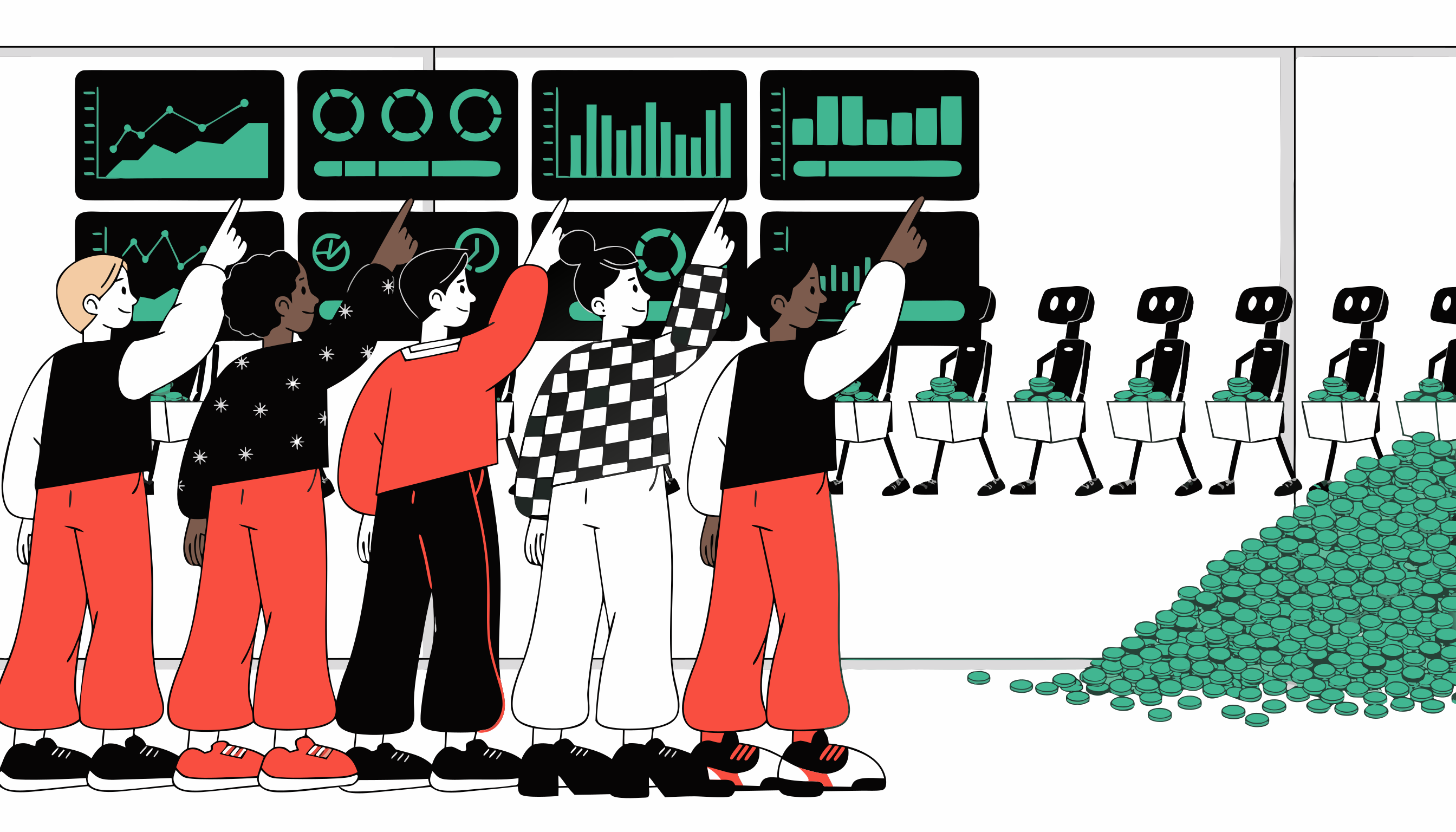
One developer goes faster. The pipeline behind them does not.


What this covers
- ✓
Why self-reported 35–50% productivity gains don't show up in cycle time — and the exact mechanism
- ✓
What the 2025 DORA report and METR controlled study actually found (the numbers vendors don't cite)
- ✓
How to identify which stage in your pipeline is the real constraint
- ✓
A YAML measurement template you can adapt for your team Monday morning
- ✓
When AI coding agents genuinely move the team metric — and the task profiles where they can't
- ✓
The organizational traps that lock in the paradox after you've already named it
Engineering leaders keep describing the same shape. Roll out an AI coding agent. Run a productivity survey two months later. Developers report shipping 35–50% faster. PR volume climbs. Then someone pulls the actual delivery numbers — cycle time, feature throughput, time-to-production — and nothing has moved. Two truths in the same dataset, and the gap between them is where most ROI conversations break down.
This is not anecdote. The METR study published in mid-2025 measured experienced developers on real-world tasks and found them roughly 19% slower with AI coding assistants — even when they expected to be faster.[1] The 2025 DORA State of AI-Assisted Software Development report found that developers perceive a 20% speed increase — yet team delivery slows 19%, while PR volume rises 98% and median review time climbs 91%.[9] A separate Anthropic survey put weekly AI agent usage at around 95% of developers.[2] Most engineering organizations have not reconciled those numbers. They live with the contradiction because the framework that explains it is not the one most leaders are reaching for.
The mechanism has a name in operations science: bottleneck shifting. AI agents accelerate code generation. The acceleration is real. The constraint is not at code generation. So the gain lands on a non-constraint stage and accumulates as work-in-progress in front of review, QA, and deployment — none of which got faster. System throughput stays flat. The traffic jam moves to a new intersection.
What the Research Actually Says
Multiple studies, contradictory surfaces, the same underlying mechanism.
~19%
Slower: experienced devs on real tasks with AI, METR 2025 controlled study. Greenfield is a different shape.
98%
More PRs per developer per week with heavy AI use, per DORA 2025. Review capacity did not double.
91%
Longer median PR review time in teams with extensive AI coding adoption, DORA 2025.
242%
Increase in incidents per PR after AI adoption — not per developer, per code change merged. DORA 2025 / Faros telemetry.
The METR finding is the most important and least-cited result in the AI coding literature. The methodology is careful: experienced developers, real tasks from their actual codebases, AI-assisted versus unassisted performance.[1] The ~19% slowdown is not a flaw in the tool. It is a measurement artifact of what the tool actually does in production work versus what it does in demos.
AI coding agents are strong on greenfield tasks with clear scope. They're weaker on the messy middle of real software: navigating existing architecture, fitting changes into established patterns, debugging interactions the agent cannot see end-to-end. Senior engineers spend most of their time in exactly that middle. The overhead of managing the agent — reviewing its output, correcting its wrong assumptions, steering it away from convincing-but-incorrect patterns — exceeds the time it saves.
The DORA 2025 data compounds this picture with team-level evidence. The 98% rise in PR volume did not translate into 98% more features delivered. It translated into 91% longer review times and a tripling of production incidents per merged change.[9] GitClear's 2025 analysis of 211 million changed lines found that code cloning (copy-paste duplication) quadrupled between 2020 and 2024, while the share of refactored and reused code fell from 25% to under 10%.[10] Agents generate more code. Less of it is load-bearing.
Both signals are real. Developers use the tools constantly and get slower on the tasks the tools are worst at, while the code they generate carries higher defect density downstream. That is not cognitive dissonance. That is what happens when a capability is widely adopted before the workflows that would make it effective have been designed.
Speed at a Non-Constraint Stage Is Just More WIP
Theory of Constraints applied to AI-augmented engineering teams.
Eliyahu Goldratt's Theory of Constraints is the cleanest frame here: any system of interdependent stages is bounded by its slowest stage — the constraint.[6] Speed up a non-constraint stage and you don't improve system output. You grow the work-in-progress queue in front of the constraint. Throughput stays flat. The queue gets longer. There's no version of it that bypasses arithmetic.
Software delivery is exactly that kind of chain: requirements clarification → code generation → code review → QA → security check → deployment. In most teams, code generation is not the constraint — it is one of the faster stages. The constraint sits in review, QA, or deployment, where work accumulates and nobody has slack. Accelerate code generation by 40% and the constraint does not move. You produce more code, faster, and the code piles up in the review queue.
The second-order effects are predictable. PR volume rises and review turnaround time rises with it — reviewers are reading more code per day with the same hours. According to Faros AI's telemetry on 10,000+ developers, PR size has grown 51% with AI adoption, making each review harder.[11] Merge conflicts become more frequent because more branches are alive simultaneously. And — critically — 31% more PRs are merging with no review at all, according to the same data.[11] The system didn't absorb the load. It bypassed the gate.
The diagram maps where the gain actually goes. Code generation accelerates. Review does not scale with it — reviewers have the same hours in the day. The extra production accumulates as a growing queue. QA and security stay at capacity. Deployment cadence is unchanged.
Teams running GitHub Copilot Enterprise reported a 55% rise in code submissions per developer per week (GitHub's own data, 2024).[4] Review backlog on those same teams grew 38% over the same window. Net effect on feature delivery time: roughly 6%. Real, but a fraction of what the individual numbers implied.
The lesson is not that AI coding agents are useless. They do real work at the task level. The lesson is that task-level gains have sharply diminishing returns when the constraint sits elsewhere in the pipeline.
The WIP queue problem is the first-order effect. The code quality problem is the second — and it compounds over time.
GitClear's 2025 study of 211 million changed lines shows that AI adoption correlates with a structural shift in how code is written.[10] The share of code classified as refactored or reused fell from 25% of changed lines in 2021 to under 10% in 2024. Code cloning (copy-paste duplication across a codebase) grew fourfold in the same period. Within a commit, copy-paste instances exceeded moved-code instances for the first time in 2024. AI agents generate — they don't refactor. The codebases receiving AI-generated code are getting bigger and more duplicated, not more maintainable.
At the incident layer, DORA 2025 data (aggregated by Faros AI across 10,000+ developers) found that incidents per PR rose 242.7% in organizations with high AI coding adoption.[11] That number deserves to be read carefully: it is not incidents per developer, it is incidents per merged code change. Every PR merged carries a much higher probability of producing a production incident than it did before AI tools. The bugs don't appear at commit time — they surface 30–90 days later, long after the productivity dashboard moved on.
For engineering leaders, this creates a measurement lag trap. The 90-day defect tail means teams can celebrate a productivity win in Q1, see it partially or fully eroded by incident load in Q2, and never connect the two. The flow-metric framework below is designed to catch this before it calcifies.
Where AI Coding Gains Actually Land
Task shapes where AI moves the team metric — and where it cannot.
Bottleneck amplifier
Feature work in mature codebases — navigating established architecture is where the METR slowdown lives
Debugging complex multi-system interactions — requires codebase context the agent cannot hold
Architecture and design decisions — judgment calls, not pattern matching
Any task that requires understanding why a system is shaped the way it is
Throughput mover
Boilerplate for new services — high pattern density, low blast radius if wrong
Test suite generation — directly expands QA capacity (the constraint), not just code volume
Documentation and API specs — low review burden, high leverage for downstream teams
Repetitive schema migrations and data transforms — deterministic, verifiable
AI review tooling (security scan, code-smell) — compresses per-PR reviewer time
The pattern across the studies is consistent. AI coding agents move team-level throughput when two conditions hold: the work is actually constrained by code-generation speed, and the work has high pattern density — the kind of shape where the agent's training data applies directly. New service scaffolding, test suite construction, migration scripts. That profile.
Work that requires understanding an existing system's idiosyncrasies, judgment calls about architecture, or debugging non-deterministic behavior doesn't fit. That work is also the majority of what experienced engineers at established companies do most days. The mismatch is structural.
The organizational implication is uncomfortable. The teams with the highest agent adoption — typically senior-heavy platform and product teams at well-funded companies — often see the weakest team-level ROI, because their work is exactly the wrong shape for the tool's current strengths.
A Measurement Framework Built on Flow, Not Feelings
Leading indicators that capture real throughput, not individual sentiment.
The measurement failure usually does as much damage as the deployment failure. Teams track individual signals — tokens generated, PR volume, satisfaction scores — and miss the system-level metrics that would tell them whether AI is helping or just relocating the queue.
A team-level ROI framework needs three layers: constraint identification (where the bottleneck actually sits), flow metrics (throughput across the full delivery pipeline), and quality-adjusted velocity (the rework AI output produces). All three. None of them is optional. Skipping any one of them is how the paradox calcifies.
- [01]
Map the delivery pipeline. Find the current constraint.
Before deploying AI coding agents — or before evaluating their impact — name the slowest stage. Run a two-week audit: for every unit of work (PR, story, feature), record time spent in each stage. The stage with the longest average wait time is your constraint. If you can't answer that question, every productivity claim downstream is unmoored.
- [02]
Track flow metrics, not activity metrics
Flow metrics measure the pipeline as a system. Four matter most for evaluating AI coding agent impact: throughput (features delivered per sprint), cycle time (commit to production), work-in-progress (items in flight), and defect escape rate (bugs reaching production). Activity metrics — keystrokes, suggestions accepted, PRs opened — measure the agent. Flow metrics measure the system. Only one of those two is worth optimizing.
- [03]
Measure quality-adjusted velocity
Raw velocity (points, PRs, features per sprint) ignores rework. Quality-adjusted velocity subtracts time spent fixing AI-generated errors, re-reviewing returned PRs, and patching AI-introduced defects. For most teams, the discount runs 15–30% on AI-generated code. Ignore it and you're reporting gross, not net.
- [04]
Expand constraint capacity before expanding AI usage
The single highest-leverage move is not better prompts. It is expanding the capacity of the actual constraint. If review is the bottleneck, rotate more reviewers, deploy automated review tooling, or reduce PR size. If QA is the bottleneck, AI-generated test suites move the team metric more than AI-generated feature code ever will.
The PR Size Lever: Your Fastest Constraint Relief
Smaller PRs review faster, fail less, and are the single most underused mitigation.
AI agents generate code fast. Left unconstrained, a developer running an agent in the background produces 500–2,000 lines of structured code in a session during which a human wouldn't finish a standup. The resulting PRs are large — and large PRs review badly. Review time degrades nonlinearly above 300 lines: reviewers lose context, start skimming, miss subtler issues. First-pass approval rates fall. Return cycles lengthen. The constraint tightens.
The fastest constraint relief — faster than adding reviewers, faster than deploying AI review tooling — is enforcing PR size discipline. Instruct agents to scope work to PRs under 300 lines, broken at logical boundaries. Stacked PR workflows (where each PR builds on the previous) let agents parallelize without producing review overload. Teams that have implemented this pattern report doubling effective review throughput without adding headcount — because reviewers who were drowning in 800-line diffs can now process three 200-line PRs in the same time with higher comprehension and lower return rates.
This is a workflow constraint, not a tool constraint. It requires a deliberate instruction layer on top of the agent: either a system prompt that imposes size limits, or a PR gate that blocks submissions over threshold. Neither is complex to implement. Both are almost universally skipped in initial rollouts.
Constraint-First Deployment Rules
[01]
Identify the constraint before deploying AI anywhere in the pipeline
Deploying at a non-constraint stage grows the queue in front of the constraint. You don't need a map of the entire pipeline — you need to know where work accumulates.
[02]
Never expand AI usage at a non-constraint stage without a downstream capacity plan
More code generation without more review capacity is a WIP accumulation strategy, not a productivity strategy.
[03]
Enforce PR size limits on AI-generated code (target: <300 lines)
Review time degrades nonlinearly above 300 lines. Large AI-generated PRs produce the highest return rates and the most review-skipping.
[04]
Segment all metrics by code origin from day one
Without AI-assisted vs. hand-written segmentation, you can't attribute quality or velocity changes. Retrofit is painful — tag at submission.
[05]
Run a minimum 8-week measurement window before drawing conclusions
The first two weeks carry novelty effect distortion. Defect tails run 30–90 days. Conclusions at 30 days are noise.
[06]
Separate developer sentiment data from delivery performance data
Both are valid. Neither predicts the other. Conflating them is how the paradox gets a press release.
Deploy AI at the Constraint, Not at the Demo
Match the tool to the bottleneck, not to the keynote.
Most organizations deploy AI coding agents at the code generation stage because that's where the demos are most polished and the surface area most visible. From a systems perspective this is exactly backwards. If review is the constraint, deploying AI at code generation increases WIP and queue depth without improving throughput. The right deployment target is the constraint.
For most engineering teams, the highest-ROI applications are not the photogenic ones. A tuned AI that generates comprehensive test suites for every PR meaningfully expands QA capacity. An AI review tool that flags obvious issues — security vulnerabilities, missing error handling, performance anti-patterns — raises first-pass approval rates and lowers reviewer burden. GitHub Copilot's code review feature reached 60 million reviews by March 2026 (up 10x from its April 2025 launch), with 71% of reviews surfacing actionable feedback at an average of 5.1 comments per PR. Neither of those plays well in a vendor demo. Both move the system metric that pays back the investment.
Review Bottleneck
AI review tooling: security scan, style enforcement, missing-test detection. Cuts cognitive load per PR. Enforce PR size <300 lines.QA Bottleneck
AI test generation: unit and integration coverage on every PR. Expands QA confidence without adding headcount.Deployment Bottleneck
AI release notes and change summaries: lower deployment coordination overhead and approval cycle time.Requirements Bottleneck
AI specification assistants: rough briefs into structured specs. Fewer stakeholder round-trips before coding begins.Debugging Bottleneck
AI log analysis and error-pattern recognition: surfaces root cause faster for on-call engineers.Leading Indicators That Predict Team-Level ROI
What to track in the first 30 days, before lagging metrics arrive.
Cycle time and throughput are lagging indicators. They tell you what already happened. For the first 30 days of an AI rollout, leading indicators do the real work — they show whether the constraint is shifting before that shift reaches the lagging metrics. By the time cycle time confirms the problem, the queue has been calcifying for a quarter.
Three signals form the most reliable early warning system.
| Metric | Type | What It Signals | Alarm Condition |
|---|---|---|---|
| PR submission rate per developer | Leading | Adoption and code generation velocity | Rising >30% with no matching rise in review capacity |
| Review queue depth (p50 wait time) | Leading | Constraint shift to review | Rising as PR volume rises — the bottleneck has moved |
| PR return rate (first-pass rejection) | Leading | AI code quality drift before QA sees it |
|
| PR size (median lines changed) | Leading | Review burden per PR | Median above 300 lines — nonlinear review time degradation begins |
| WIP (items in flight) | Leading | System-wide queue accumulation | Rising with flat throughput — work enters faster than it exits |
| Cycle time (commit to deploy) | Lagging | System throughput change | Unchanged or rising after 60+ days |
| Defect escape rate (bugs to production) | Lagging | AI code quality at the system level — has 30–90 day lag | Segment by code origin; alarm if AI-assisted density >1.5x hand-written |
The Org Traps That Lock In the Paradox
Why the gap persists even after leaders see it in the data.
The bottleneck shift is not primarily a technical problem. It's a measurement and incentive problem. Three organizational dynamics keep teams stuck in the paradox even when the data clearly shows it.
Teams that discover the bottleneck shift often double down on the wrong fix: faster models, better prompts, more agent parallelism. All of those increase code generation velocity and make the review queue worse. The reflex when throughput stalls is to invest in code quality at the generation stage. The actual fix is expanding capacity downstream. Reflex and fix point in opposite directions.
Incentives point at the wrong layer
Individual developers are rewarded for shipping code, not for managing review queues
Engineering managers are measured on sprint velocity (output), not cycle time (flow)
AI vendor renewals depend on adoption rates and usage hours, not delivery improvement
The people who own the constraint stage (QA, security) are rarely in the AI rollout conversation
Attribution is claimed at the wrong level
Developer productivity surveys go up — that claim goes in the board deck
Cycle time stays flat — that fact stays inside engineering
Different people own each fact, so the gap between them is never reconciled
Vendor dashboards default to individual-level metrics, reinforcing the wrong measurement layer
Adoption manufactures pressure to confirm ROI
Once licenses are purchased, organizational gravity bends toward justifying the spend
Teams select favorable metrics rather than running a genuine before/after comparison
95% adoption means most engineers are using the tools — raising the lack of throughput improvement is politically expensive
What Engineering Leaders Should Do Differently
A concrete plan for teams that want honest ROI, not survey theater.
How to Frame This for Executives
Bottleneck-shift reality, translated for an audience that approved the budget.
The hardest part of this conversation is rarely the analysis. It's the framing. Leaders who approved the AI coding agent budget have a stake in seeing positive ROI. "Our developers are 40% faster at code generation, and we haven't improved delivery time" doesn't land cleanly without context.
The framing that works: reposition the agent as a capacity expansion investment, not a productivity silver bullet. The tool is not eliminating waste. It is shifting where capacity is needed. Without matching investment in review and QA capacity, you're buying a faster car and putting it on a clogged highway.
Two points leadership has to hear cleanly. First: the bottleneck must move before team-level ROI shows up, and moving the bottleneck is a process and capacity investment, not a tool purchase. Second: the leading indicators tell you in 30 days whether you're on track — well before the lagging indicators force a harder conversation at 90.
The Paradox Has a Resolution
Individual and team gains can coexist — but only if you manage the full system.
The paradox is real. It's not permanent. Individual gains can translate into team-level throughput improvements. The path requires managing the constraint, not just the tool.
Three steps. Identify the constraint before deploying AI. Deploy AI where it expands the constraint's capacity — which often means test generation or review tooling, not feature coding. Track flow metrics for the full pipeline, not just task speed. Enforce PR size discipline so agents generate reviewable units, not review backlog.
Teams that do this report 20–35% cycle time improvements within a quarter of targeted AI deployment. Teams that don't — that ship coding assistants and measure satisfaction — end up exactly where the paradox predicts. Everyone feels more productive. Delivery doesn't improve. Nobody can name the cause.
The METR 19% slowdown and the DORA 2025 data aren't the end of the AI coding story. They're a corrective to the vendor narrative. The right question for engineering leaders is never "are developers faster?" It's "is the system delivering faster?" Those two questions have different answers. Only one of them is worth optimizing for.
If developers report 40% time savings, why doesn't throughput improve?
Because code generation is rarely the constraint in a mature delivery pipeline. The bottleneck typically sits in review, QA, or deployment. When AI accelerates code generation, it produces more work-in-progress that accumulates in front of an unchanged constraint. The DORA 2025 report found 98% more PRs per developer alongside 91% longer review times — the pipeline received more input than it could process. The individual saving is real. The system effect depends on whether the constraint moves. Most rollouts don't move it.
How do we know if code review is our bottleneck?
Track stage wait times. For every PR, record how long it spends waiting for a reviewer versus actively in review. Industry baseline: PRs sit idle roughly 3 days before first review at the median. If yours is longer, review is almost certainly your constraint. If QA or deployment is the constraint, those stages will show the same accumulation pattern. You don't have to guess — the queue tells you.
What's the fastest way to expand review capacity alongside AI coding tools?
Three approaches, ranked by speed. First, reduce PR size — smaller PRs review faster and first-pass approval rates climb. Instructing agents to submit PRs under 300 lines, broken at logical boundaries, can double effective review throughput without adding headcount. Second, deploy AI review tooling — security scanners, code-smell detectors — to compress per-PR reviewer time. Third, add reviewer capacity by rotating senior developers through dedicated review windows (2-hour blocks, twice daily) instead of ad-hoc. Most teams do none of these when they roll out AI coding agents. That is why the paradox persists long after it is named.
Is the METR 19% slowdown applicable to all teams?
No. The METR study tested experienced developers on real, complex tasks from their own codebases. The slowdown is most pronounced for that profile — senior engineers in mature, complex systems. Junior developers on new projects with high boilerplate density often see genuine gains. Match the tool's strength to the team's profile or accept that the headline number doesn't apply to you.
What does the 242% increase in incidents per PR actually mean?
It means the probability that a given merged PR produces a production incident has more than tripled in organizations with high AI coding adoption, according to DORA 2025 data aggregated by Faros AI across 10,000+ developers. This is incidents per code change, not per developer — so the volume increase from AI adoption amplifies the effect further. The defects typically surface 30–90 days post-merge, creating a measurement lag that disconnects the productivity win from the incident spike.
How long should we run a post-deployment measurement period before drawing conclusions?
Minimum 8 weeks for lagging metrics (cycle time, defect rate) to mean anything. Leading indicators (review queue depth, WIP) give useful signal in 3–4 weeks. The first two weeks are contaminated — novelty effect and the workflow disruption of adopting any new tool both distort early data. Anyone declaring victory inside 30 days is reporting noise. For defect escape rate specifically, run a 90-day window — that's where the AI code quality tail plays out.
A note on the studies cited
The METR study measured experienced developers on autonomous tasks, not co-pilot-style assisted coding. The Anthropic survey measured self-reported usage frequency, not performance outcomes. DORA 2025 data is survey-based (nearly 5,000 developers) plus telemetry aggregated by Faros AI (10,000+ developers) — the incidents-per-PR and review-time figures come from the Faros telemetry layer, not the DORA survey directly. The GitClear data covers 211 million changed lines from 2020–2024 and measures code-level patterns, not delivery outcomes. All are cited for the legitimate tensions they create, not as definitive proof for any single claim.
Key terms in this piece
AI coding agent ROIdeveloper productivity AIengineering team throughputbottleneck theory softwareAI coding tools measurement
- [1]METR: Benchmarking AI R&D Capabilities — Experienced Developers 19% Slower with AI Assistants(metr.org)↩
- [2]Anthropic: Claude Usage Survey — 95% of Developers Use AI Agents Weekly(anthropic.com)↩
- [3]arXiv: AI-Assisted Developer Productivity — Controlled Study(arxiv.org)↩
- [4]Stripe: Developer Productivity with AI — GitHub Copilot Enterprise Data(stripe.com)↩
- [5]McKinsey: Unleashing Developer Productivity with Generative AI(mckinsey.com)↩
- [6]Goldratt Institute: Theory of Constraints(goldratt.com)↩
- [7]InfoQ: AI Coding and Team Throughput — Systems-Level Analysis(infoq.com)↩
- [8]ACM Queue: Software Development Bottlenecks and Flow Metrics(queue.acm.org)↩
- [9]DORA Research Team — DORA: State of AI-Assisted Software Development 2025(dora.dev)↩
- [10]GitClear Research — GitClear: AI Copilot Code Quality 2025 — 4x Growth in Code Clones(gitclear.com)↩
- [11]Faros AI — Faros AI: Key Takeaways from the DORA Report 2025(faros.ai)↩
Related
Governance
Inference Budget Governance: The Hidden Finance Problem in Scaling Agents
Why production inference bills always exceed estimates — and the Finance-Engineering governance framework for per-agent budgets, model routing, context compression, and cost forecasting without capability degradation.
Apr 30, 202622 min read

GovernanceFeatured
AI Proof of Concept to Production: The 90-Day Gate That Ships It or Kills It
46% of AI proofs of concept never ship. The gap is not technical. It is structural: PoC culture rewards experimentation and punishes shipping. A 90-day decision gate, an operational owner, and an incentive rewrite — or pilot purgatory wins again.
Mar 31, 202621 min read

Governance
Retiring Production AI Agents: 5 Phases Before the Credentials Go Stale
Launches get conference talks. Retirements get archived repos and live credentials. Five sequential phases — audit, extract, shadow, communicate, shut down — and the security blast radius when you skip any of them.
Mar 27, 202620 min read