All pieces
Governance & Adoption
Inference Budget Governance: The Hidden Finance Problem in Scaling Agents
Why production inference bills always exceed estimates — and the Finance-Engineering governance framework for per-agent budgets, model routing, context compression, and cost forecasting without capability degradation.
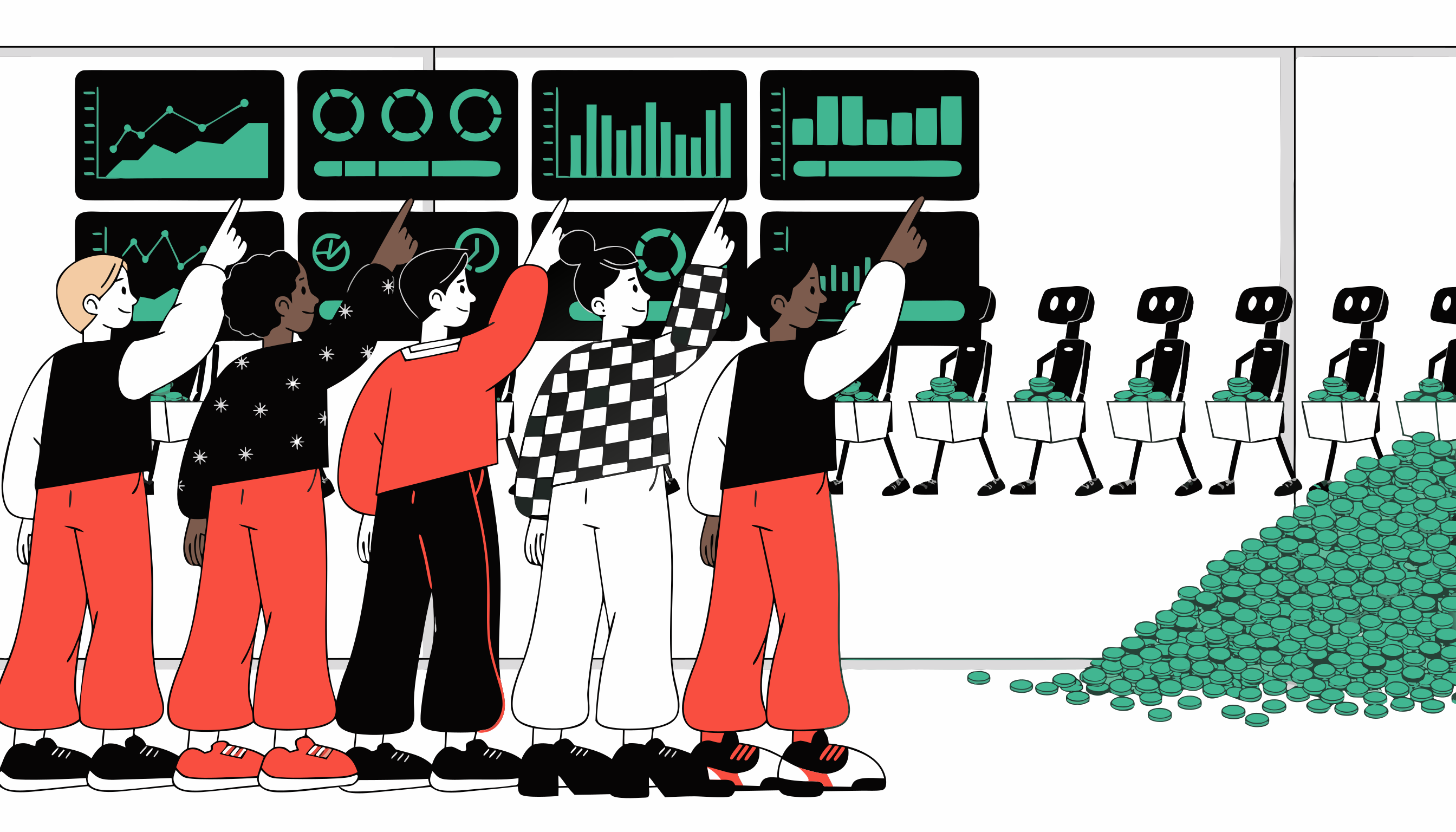

Three months after shipping their research pipeline, a team found an $89,000 API bill. The agents were running successfully — every quality metric was green, latency was acceptable, users were happy. But each research request was feeding a fresh 150,000-token context window to Claude Opus on every reasoning step. Nobody modeled that. The bill arrived on Tuesday. The CFO asked for an explanation on Wednesday. By Thursday, the team had manually throttled the pipeline to a trickle.
This is inference bill shock, and it follows a pattern almost every team scaling agents eventually hits. They build cost estimates from single-call benchmarks — accurate for a clean system prompt plus response. Then they deploy agents that iterate: accumulating context across steps, spinning up subagents that inherit that context, retrying on failures without any budget awareness. A 10-turn research agent with 20,000 tokens of context per turn doesn't cost 200,000 tokens — it costs 1.1 million, because each step retransmits everything that came before it.
Agentic workflows consume 5–30x more tokens per task than standard chatbot queries[8], output tokens cost 3–5x more than input tokens across all providers[2], and multi-agent pipelines multiply these effects by the number of agents operating in parallel. The combination turns a $0.05 per-request estimate into a $5 per-request reality. Inference budget governance — treating token capacity as a managed resource with per-agent quotas, model routing policies, context compression, and a Finance-Engineering operating cadence — is how teams stop discovering this math on the billing page.
Why bills spike
The 3 structural failure modes that cause every inference overspendPer-agent enforcement
SDK-level budget controls with graceful degradation in TypeScriptModel routing
Task-class routing table: Haiku → Sonnet → Opus by cognitive loadContext compression
Structured summaries between steps instead of raw history retransmissionGovernance cadence
Pre-launch, weekly, and quarterly Finance-Engineering operating rhythmWhy production inference bills always exceed estimates
The structural reasons single-agent benchmarks fail to predict multi-agent costs
The core problem isn't that agents are expensive — it's that single-agent cost models don't predict multi-agent costs at all.
When engineering estimates cost per request, they measure a clean single call: system prompt + user message + response. That measurement is accurate. It just doesn't describe what happens in production, where agents iterate.
A research agent analyzing a competitor landscape doesn't ask one question. It asks eight, accumulates the answers into a growing context window, then runs a synthesis pass against all of it. Each reasoning step retransmits the full accumulated context. Add multi-agent orchestration, and the multiplier compounds: each subagent receives a context including the orchestrator's full reasoning trace, its own history, and every tool call output accumulated so far. A three-agent pipeline doesn't cost 3x the single-agent price — it costs 6x, because every fan-out step carries accumulated context from everything upstream.
Then there's the loop problem. In November 2025, two LangChain-based agents entered an infinite conversation cycle that ran for 11 days, generating a $47,000 API bill before anyone caught it[3]. According to a 2025 State of AI Cost Management survey, 80% of enterprises underestimate their AI infrastructure costs by more than 25%[4]. The teams that avoid surprises share one trait: they treat inference budget as a first-class design constraint before launch, not a monitoring dashboard to check after something goes wrong.
96% of enterprises report that AI costs exceeded their initial projections[1]. A Gartner survey of 353 D&A and AI leaders found that only 44% of organizations have adopted financial guardrails or AI FinOps practices — meaning a majority are still running agentic workloads with no per-session cost ceiling[9]. That's not a forecasting failure; it's an architectural one.
96%
Enterprises reporting AI costs exceeded initial projections
Zylos Research, Feb 2026
5–30×
More tokens per task in agentic vs. standard chatbot workflows
Gartner, March 2026
$47,000
Cost of a single agent loop left uncaught for 11 days
LangChain incident, November 2025
44%
Enterprises with financial guardrails or AI FinOps in place
Gartner survey, 353 D&A/AI leaders, 2025–2026
The three cost failure modes in production agent systems
Each is preventable — but only if identified before launch, not during incident review
Most inference budget problems trace to three structural failures that compound each other.
Context accumulation without pruning. Multi-turn agents retransmit full conversation history on every step. A 20-step research agent with 10,000 tokens of context per turn spends 1.1 million input tokens total — not 200,000 — because step N pays for all N-1 previous steps plus the new input. Tool call outputs are the primary offender: file contents, command results, and API responses frequently consume 70–80% of the available token budget even on early steps[10]. The fix isn't reducing context size arbitrarily; it's passing structured summaries between steps rather than raw transcripts. Research on autonomous context compression (the Focus architecture, January 2026) showed 22.7% average token reduction while maintaining identical task accuracy, with savings up to 57% on individual long-horizon tasks[11].
Reflexive frontier model use. Teams default to their best model for everything, which feels safe but doesn't make economic sense. Claude Haiku 4.5 runs at $1/$5 per million tokens; Sonnet 4.6 at $3/$15; Opus 4.6 at $5/$25[5] — a 5x cost gap between Haiku and Opus. On tasks where Haiku or Sonnet delivers adequate quality (most classification, extraction, formatting, and routine content generation), using Opus is a direct cost premium for near-zero quality gain. Routing 70% of production requests to a model that costs 5x less drops the weighted average cost per request by 40–70%[12].
Hard stops without graceful degradation. Engineering teams often implement budget caps as exceptions: when the limit is hit, the agent throws an error. Hard stops cause silent failures, retry storms, and compounding costs. Users see errors and retry. The retry itself may breach the next budget tier. The correct pattern is three-tier response: warn at 80% of budget, downgrade model and compress context at 90%, return a partial result at 100%. An honest partial result preserves more user trust than an unhandled exception — one production system went from 99.2% to 99.87% uptime by replacing hard stops with graceful fallbacks[13].
Building the Finance-Engineering contract before launch
The organizational agreement that prevents bill shock — structured for teams that don't know where to start
The organizational piece of inference budget governance is systematically underbuilt. Platform engineers implement cost controls. Finance tracks monthly invoices. Neither talks to the other until the bill is already a surprise. By that point, the conversation is adversarial rather than collaborative.
The contract that prevents this has three components.
A shared cost model built before launch. Engineering provides Finance with: estimated token counts per agent task class at P50 and P95 confidence, expected request volume by workflow, and model tier assignments per task type. Finance provides: a monthly budget envelope per product area and escalation thresholds that trigger review. The shared output is a per-workflow cost forecast. P50 is the operating target; P95 defines the alert boundary. Without this document, nobody knows whether a 40% month-over-month cost increase signals success (volume grew 60%) or failure (efficiency collapsed).
Per-agent cost attribution. Every inference request needs to emit a structured cost event: agent ID, workflow ID, product area, model tier, input tokens, output tokens, and cache hit status. Without attribution, you can see total spend but not the cause. With it, anomalies become diagnosable: "the document analysis agent in the compliance workflow consumed 3x its P95 budget because a new document format triggered verbose extraction chains" is actionable. "Our total API spend was 40% over forecast" is not.
A weekly governance cadence. Finance and platform engineering review the cost report together — weekly, not monthly. The latency between anomaly and detection should be measured in days. A team reviewing weekly catches a runaway agent in the current sprint. A team reviewing monthly catches it after four weeks of damage. This cadence also builds the usage history needed to negotiate provider discounts: committed spend tiers typically yield 15–30% reductions at moderate volumes[2], but you need reliable projections to negotiate confidently.
Reactive cost management
Cost modeled from single-call benchmarks
Provider spend caps as the only guardrail
Monthly billing review catches overruns after the fact
Frontier model used by default for safety
No attribution below the team level
Engineering owns cost; Finance sees invoices
Inference budget governance
Per-workflow cost forecasts with P50 and P95 projections
SDK-level per-agent quota enforcement with graceful degradation
Weekly Finance-Engineering review with anomaly triage
Task-class model routing: Haiku → Sonnet → Opus by complexity
Cost attributed to agent ID, workflow ID, and product area
Shared cost model with Finance sign-off before launch
Per-agent budget enforcement in code
SDK-level controls with graceful degradation — the implementation teams actually ship
Budget enforcement has to happen at the SDK layer. Monitoring tells you what you spent. SDK-level enforcement controls what you can spend — and shapes how the agent behaves when approaching a limit.
The minimal pattern: wrap every agent execution with a budget tracker that holds a per-trace token ceiling. As the ceiling approaches, the agent downgrades to a cheaper model. At 90% of budget, it compresses working context. At 100%, it returns a partial result rather than an exception. The user gets a degraded-but-useful response. No retry storm. No silent failure.
One practical constraint: never downgrade two model tiers mid-task. Jumping Opus → Haiku on a multi-step reasoning task breaks continuity. The safe path is Opus → Sonnet → partial result. Sonnet handles the vast majority of continuation work at near-Opus quality on standard tasks; Haiku is only appropriate for bounded, simple subtasks where cognitive demand is genuinely low.
Context compression: cut costs 40–57% without touching model selection
Structured summaries between agent steps are faster to implement than model routing — and often the bigger win
Model routing is the right-model-for-the-task problem. Context compression is the stop-retransmitting-everything problem. Both matter, but compression is often the faster win: it requires no judgment about task complexity and doesn't risk capability regression.
The default behavior of most agent frameworks is append-only context: every tool output, every prior assistant turn, everything. That's the right default for correctness. It's the wrong default for cost. Tool call outputs — file reads, search results, API responses — routinely consume 70–80% of the token budget across all agent steps, even when 90% of that content is irrelevant to the current reasoning step[10].
The compression pattern that works in production: structured handoff at each step boundary. Instead of passing the raw conversation history, pass a fixed-schema JSON summary that captures what matters — current task state, decisions made, constraints discovered, files modified, open questions. Subsequent compressions update this document rather than regenerating it from scratch. Research on the Focus architecture (Verma, 2026) showed 22.7% average token reduction on long-horizon coding tasks while preserving identical accuracy, with up to 57% savings on individual instances where context bloat was severe[11].
The practical threshold: trigger compression when accumulated context exceeds 50–60% of your target window. Below that, compression adds latency with minimal savings. Above it, every additional step's cost grows faster than the reasoning value it adds.
Compression and caching compose well. Cache the stable parts of the system prompt (instructions, shared knowledge base) and compress the dynamic parts (conversation history, tool outputs). That combination — cache reads at 10% of base input cost[5], compressed history at 40–60% of naive size — can cut total input token costs by 60–80% on high-frequency agents.
Model routing without capability degradation
Task-class routing is the highest-impact cost control — and the one most teams implement wrong
Model routing is the highest-impact inference cost control available. Teams either route everything to the frontier model (expensive by default) or try to route everything to the cheapest model (breaks tasks, causes retries that compound costs). Both miss the point.
The routing decision lives at the task level, not the session level. A single agent session might use Opus for the planning step, Sonnet for document extraction and analysis, and Haiku for formatting the final output. This isn't a quality compromise — it's matching cognitive load to model capability.
Routing 70% of requests to a model that costs 5x less drops the weighted average cost per request by 40–70%[12]. The word measurable matters here: there's a persistent assumption that cheaper models perform dramatically worse on real workloads. But 60–80% of production agent requests are routine — formatting, extraction, classification, boilerplate generation — where the gap between Haiku and Opus quality is negligible[12].
The routing decision needs its own benchmark. Public benchmark scores (SWE-bench, GPQA) are proxies for academic task distributions, not your production traffic. Before committing to routing rules, run your specific task mix through each model tier and measure quality on your own evaluation criteria. Teams that get routing wrong almost always set rules based on intuition rather than their own benchmarks.
| Task Type | Default Model | Cost per MTok (in/out) | Escalate When |
|---|---|---|---|
| Text classification, labeling | Haiku 4.5 | $1 / $5 | Ambiguous categories exceed 30% of samples |
| Structured data extraction, formatting | Haiku 4.5 | $1 / $5 | Fields require domain inference, not pattern matching |
| Content generation, summarization | Sonnet 4.6 | $3 / $15 | Specialized domain, regulatory, or high-stakes output |
| Code generation and review | Sonnet 4.6 | $3 / $15 | Security-critical paths, large codebase refactors |
| Multi-step planning, task decomposition | Opus 4.6 | $5 / $25 | Always appropriate — sustained reasoning is Opus's core advantage |
| Compliance review, security audits | Opus 4.6 | $5 / $25 | Always appropriate — error cost exceeds model premium |
| Long-context synthesis (100K+ tokens) | Opus 4.6 | $5 / $25 | Default — smaller models lose coherence at scale |
Context caching: the fastest win most teams implement last
For high-frequency agents with stable system prompts, caching often pays off within a day
Model routing handles the model selection decision. Context caching handles the repeated-context problem — and it's often the easier win to implement first.
Most agent systems send the same system prompt and shared knowledge base on every request. Without caching, those tokens are billed at full input rate every call. Anthropic's prompt caching prices cache reads at 10% of standard input cost[5]. For a 50,000-token system prompt called 1,000 times per day, that's the difference between paying $150 per day and $15 per day — just for the system prompt portion.
The implementation is lightweight: mark stable context with cache_control in the API request. The cache is valid for up to one hour per write. For high-frequency agents, the cache write cost (1.25x standard input price) is recovered after a single subsequent cache read[5]. Real-world implementations consistently report 59–90% cost reductions on the cached portion — ProjectDiscovery cut their LLM costs 59% in initial rollout, reaching 66% after prompt optimization[14].
Caching and compression compose. Cache the stable parts of the system prompt (instructions, knowledge base), compress the dynamic parts (conversation history, tool outputs). Together, they can cut total input token costs by 60–80% on agents with high request frequency and stable instructions.
The governance operating rhythm
Technical controls without organizational cadence decay — here's the rhythm that keeps them sharp
- [01]
Pre-launch: Define the cost model with Finance
Before any agent ships, engineering produces token estimates by task class at P50 and P95. Finance approves a monthly budget envelope per product area and sets alert thresholds — typically at 50%, 80%, and 100% of the envelope — with a defined response for each threshold: monitor, review, halt. The output is a mutual cost contract, not a dashboard to check later. This document also defines what happens when each threshold fires, so the response isn't improvised during an incident.
- [02]
At launch: Enable per-agent cost attribution
Every inference request must emit a structured cost event: agent ID, workflow ID, product area, model used, input tokens, output tokens, and cache hit status. Wire these to your observability platform — OpenTelemetry span attributes work well. Without attribution, governance is blind. You can see total monthly spend but cannot identify which agent or workflow drove it.
- [03]
Weekly: Review and triage anomalies
Finance and platform engineering spend 30 minutes reviewing the cost report together. Flag any workflow spending above P95 for its task class. Assign an investigation owner with a 48-hour resolution window. Most anomalies have simple explanations — context size creep from a new document type, a high-volume customer, a tool schema change that bloated prompt size. Finding these weekly keeps incidents at sprint scope rather than quarterly scope.
- [04]
Monthly: Rebalance model routing
Model pricing changes. New tiers emerge. What required Opus six months ago may be Sonnet territory now — capability gaps narrow as smaller models improve. Every month, re-run the routing decision matrix against current pricing and current benchmark data for your specific task mix. Routing rules set six months ago and never revisited are almost certainly leaving money on the table.
- [05]
Quarterly: Renegotiate the budget envelope
As usage patterns mature, P50/P95 estimates improve. Refine the budget commitments to match. If spend consistently runs 30% below budget, propose reallocating that margin to new agent capabilities. If spend consistently exceeds P95, audit model routing decisions and context compression before requesting a budget increase — the routing rules may simply need updating, which costs nothing. This cadence also produces the usage history needed to negotiate committed-spend discounts with providers.
Common traps in inference budget implementation
Most of these only reveal themselves after they've already cost money
Technical failure modes
Hard stops instead of graceful degradation — throwing exceptions when budgets are exceeded causes user-facing errors and retry storms that compound the exact costs you were trying to control
Jumping two model tiers mid-task (Opus → Haiku) — breaks multi-step reasoning continuity and triggers retries that cost more than staying on Opus would have
Org-level spend caps without per-agent attribution — you know you're over budget but cannot identify which agent, workflow, or customer caused it
Treating context window as a default rather than a ceiling — filling 200K windows on every step when 5,000 tokens of structured summary would suffice
Treating provider spend caps as primary controls — by the time a provider cap fires, requests are failing for users; SDK enforcement is the operational layer
Skipping compression on tool outputs — file contents and API responses routinely consume 70–80% of the token budget and can be replaced with structured summaries at near-zero quality cost
Organizational failure modes
Finance reviewing cost monthly instead of weekly — a runaway agent running 21 days before detection costs 4x more than one caught in five days
Cost model built from demo benchmarks, not production traces — underestimates by 5–30x because demos don't have the context accumulation of real iterative agent tasks
No pre-launch cost approval gate — engineering ships agents without Finance alignment on budget expectations, turning every bill surprise into a trust problem
Token budget governance owned entirely by the platform team — Finance has no visibility until the invoice, leaving no opportunity for proactive reallocation or renegotiation
Inference budget enforcement rules
[01]
Every agent must have a named token budget ceiling before shipping to production
No ceiling means no enforcement. The P95 token estimate from staging traces is the ceiling — not the P50, not an intuition.
[02]
Budget enforcement belongs in the SDK layer, not the provider layer
Provider caps halt all requests without discrimination. SDK enforcement allows graceful degradation, per-agent tracking, and model downgrade — all invisible to the user.
[03]
Never jump two model tiers mid-task
Opus → Haiku mid-reasoning breaks task continuity. The safe path is Opus → Sonnet, then partial result. Each step down should be a one-tier drop.
[04]
Compress context before the 60% window threshold, not after it
Compression triggered at 80% is too late — costs are already compounding. Set the trigger at 50–60% utilization to stay ahead of exponential growth.
[05]
Cost attribution must be per-agent and per-workflow, not per-team
Team-level attribution tells you which team is over budget. Agent-level attribution tells you which specific workflow, on which specific day, and why.
Questions practitioners actually ask
The governance questions without clean answers in the documentation
What's a reasonable per-agent monthly token budget for a production research agent?
There's no generalizable number — it varies too much by request volume, context size, and task complexity. The useful approach: instrument one week of staging traces, compute P50 and P95 token spend per task class, then multiply by expected production request volume. Use the P95 number as your budget ceiling for Finance approval, and set your alert threshold at 80% of that. For a rough sanity check, a research agent making 100 requests per day with 50,000-token contexts on Sonnet 4.6 runs roughly $2,000–$3,000 per month before caching — but your actual number could be 5x higher or lower depending on iteration depth and context accumulation. Enable caching on the stable system prompt portion first; that alone often cuts 40–60% of input token costs.
Should budget caps be enforced at the provider level or the SDK level?
Both — but for different reasons. Provider caps are your last-resort backstop against catastrophic incidents; set them high enough to not interfere with normal operations. SDK-level caps are your operational controls: they enforce graceful degradation, give you per-agent visibility, and let you route dynamically based on budget state. Relying only on provider caps means your first signal of a runaway agent is requests failing wholesale for users — worse for experience and harder to diagnose than a graceful partial-result response.
How much reasoning quality do we actually lose when routing to cheaper models?
On most standard production tasks — extraction, summarization, formatting, routine code generation — the measurable quality difference between Sonnet 4.6 and Opus 4.6 is under 5%. The gap widens on tasks requiring sustained multi-step reasoning, novel domain synthesis, or high-stakes judgment with sparse signal. Before committing to routing rules, run your specific task mix through both models and measure quality on your own criteria. Public benchmark scores on academic datasets are a proxy; your task distribution is the ground truth. Teams that get routing wrong almost always set rules based on intuition rather than their own benchmarks.
What's the fastest way to cut inference spend if we're already over budget?
In order of implementation speed: (1) Enable prompt caching on stable system prompts — takes hours, saves 40–80% on input tokens for high-repetition context. (2) Add context compression between agent steps — pass structured summaries of prior results instead of full conversation transcripts. Research shows up to 57% token reduction on individual long-horizon tasks with maintained accuracy. (3) Audit model assignments — identify any task classes currently running on Opus that your own benchmark data shows Sonnet handles adequately. These three steps together typically reduce spend by 50–70% without any product-visible changes.
When should the agent warn vs. downgrade vs. return a partial result?
Warn at 80% of budget — log the event, optionally surface to an operator, do not change agent behavior yet. Downgrade model at 90% — switch to the next-cheaper tier (one tier only), compress context by summarizing earlier work rather than retransmitting it. Return a partial result at 100% — complete the current reasoning step and halt gracefully with whatever has been computed. Never throw an unhandled exception as the budget enforcement response. Silent failures and unhandled errors erode user trust far faster than an honest partial result.
How often should we revisit routing rules?
Monthly at minimum. Model pricing drops, new tiers emerge, and capability gaps narrow as smaller models improve. Routing rules set six months ago against a different pricing and model landscape are almost certainly suboptimal. Run your task mix through the current model lineup monthly, compare cost-to-quality ratios, and adjust. A one-hour monthly review of routing rules and benchmark data has paid for itself within a week at production volumes.
The pattern across every team that gets this right is the same: they treat inference budget as an architectural constraint during system design, not a financial dashboard to check after launch. The cost model, the compression strategy, the routing rules, the Finance-Engineering cadence — all of it needs to be in place before the first production request, because retrofitting budget controls onto a live agent system is an order of magnitude harder than building them in from the start. A runaway agent is a people problem before it's a technical one. The teams that avoid $47,000 surprises are the ones where an engineer and a finance partner reviewed a cost model together before any code shipped.
Key terms in this piece
inference budget governanceLLM agent cost controlper-agent token budgetmodel routing costAI inference cost forecastingagent cost management
- [1]Zylos Research — AI Agent Cost Optimization: Token Economics and FinOps in Production(zylos.ai)↩
- [2]Digital Applied — LLM API Pricing Index: AI Agent Deployment Costs Guide(digitalapplied.com)↩
- [3]DEV Community — How an AI Agent Ran Up a $47,000 Bill in 11 Days (And How to Stop It)(dev.to)↩
- [4]Matthew Diakonov — Stop Burning Money on API Fees(fazm.ai)↩
- [5]Anthropic — Claude API Pricing — Anthropic Documentation(docs.anthropic.com)↩
- [6]NxCode — Sonnet vs Opus: Which Claude Model to Pick (2026)(nxcode.io)↩
- [7]Claude Skills Guide — Claude Haiku vs Sonnet vs Opus Cost Breakdown 2026(claudecodeguides.com)↩
- [8]Gartner — Gartner Identifies Three Pillars for Deriving Value from AI(gartner.com)↩
- [9]Atlan — Gartner D&A Summit 2026: Key Takeaways on Context and AI(atlan.com)↩
- [10]Factory.ai — Evaluating Context Compression for AI Agents(factory.ai)↩
- [11]Nikhil Verma — Active Context Compression: Autonomous Memory Management in LLM Agents(arxiv.org)↩
- [12]Morph — LLM Cost Optimization: 5 Levers to Cut API Spend 70-85%(morphllm.com)↩
- [13]Brandon Lincoln Hendricks — Circuit Breaker Patterns for AI Agent Reliability: A Production Implementation Guide(brandonlincolnhendricks.com)↩
- [14]ProjectDiscovery — How We Cut LLM Costs by 59% With Prompt Caching(projectdiscovery.io)↩
Related
GovernanceFeatured
AI Proof of Concept to Production: The 90-Day Gate That Ships It or Kills It
46% of AI proofs of concept never ship. The gap is not technical. It is structural: PoC culture rewards experimentation and punishes shipping. A 90-day decision gate, an operational owner, and an incentive rewrite — or pilot purgatory wins again.
Mar 31, 202621 min read

Governance
Retiring Production AI Agents: 5 Phases Before the Credentials Go Stale
Launches get conference talks. Retirements get archived repos and live credentials. Five sequential phases — audit, extract, shadow, communicate, shut down — and the security blast radius when you skip any of them.
Mar 27, 202620 min read

Governance
Auditing Third-Party MCP Servers: A 0-100 Security Scorecard, Gated in CI
Third-party MCP servers run inside your agent's reasoning loop with privileged tool access. Most teams added them without a review process. A 0-100 scorecard across provenance, scope, code, network, and runtime — gated in CI before they ship.
Mar 23, 202621 min read