All pieces
AI Engineering Platform
Prompt Contract Versioning: Stop Breaking Multi-Agent Systems on Deploy
How to apply semantic versioning and consumer-driven contract testing to AI agent system prompts — treating prompts as versioned API contracts with explicit breaking change classification, agent manifests, and CDC-style registration for multi-agent production systems.
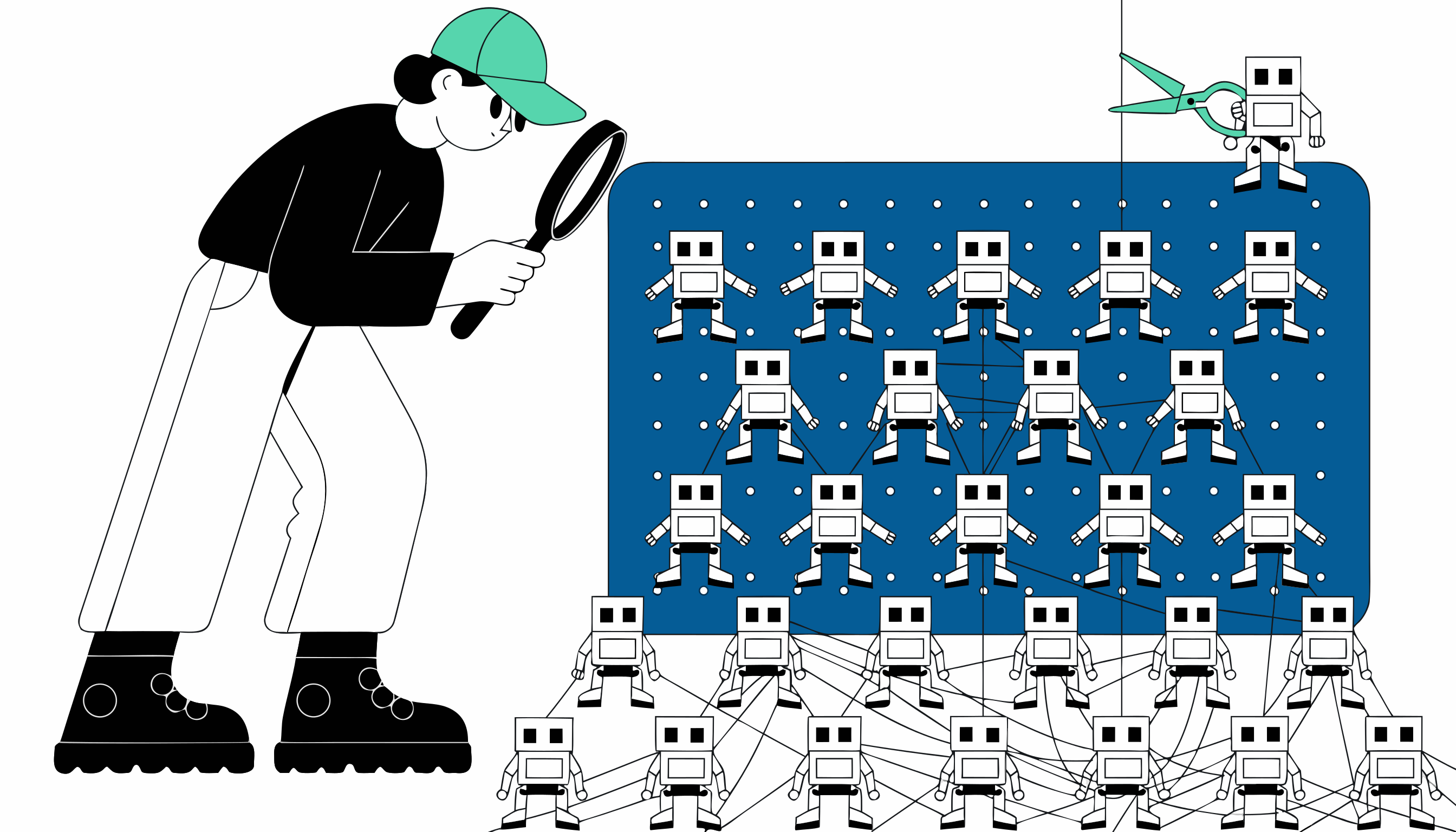

The most dangerous prompt change in a production multi-agent system is the one labeled "minor cleanup." Not a model swap. Not a new tool integration. A platform team added a sentence to a customer support agent's system prompt to clarify escalation tone. They ran five manual tests. It looked better. They shipped it.
Three days later, a routing orchestrator upstream began misclassifying 12% of escalated tickets — because that orchestrator was extracting a priority signal from a specific clause the "cleanup" had reworded. Nobody had documented the dependency. It surfaced in ticket quality data two business cycles later, not in monitoring.
That failure pattern has a name: an implicit output format dependency in a downstream consumer, broken by an undocumented prompt change. It's the core problem that prompt contract versioning exists to solve.
Prompt contract versioning treats every production system prompt as a versioned interface with defined downstream consumers, documented output contracts, and explicit breaking change classification. The discipline borrows directly from API versioning. The mechanics need adaptation for probabilistic, prose-heavy LLM outputs — but the governance logic is identical.
Prompt registries — the standard tooling recommendation for this problem — manage versions and enable rollback. What they don't do: tell you which downstream systems depend on specific output fields, or block a change that removes those fields before it reaches production. That gap is where silent failures live.
3-tier
Major · Minor · Patch taxonomy for every system prompt changeSilent
Format dependencies in downstream agents that no code review will catchManifest
The agent manifest pattern — mapping each agent's active prompt to the contracts it satisfiesImmutable
Published prompt versions are never modified in place — changes always create new versionsCDC
Consumer-Driven Contract Testing that blocks breaking changes in CI before they reach production3-tier
Version classification
Major · Minor · Patch — applied to every prompt change before committing
30 days
Deprecation window
Minimum notice to registered consumers before any major version hard cutover
5%
Shadow divergence threshold
Output divergence above this rate blocks major version cutover until root cause is known
The Implicit Contract Problem
Why prompt registries alone are not enough to prevent production failures
Software engineering has a well-developed vocabulary for interface contracts. When a REST API removes a field, the provider bumps a major version, communicates the deprecation, and gives consumers a migration window. The contract between provider and consumer is explicit, versioned, and observable.
Production AI agents have a contract too. Almost nobody treats it like one.
An agent that produces structured output — a JSON response, a formatted report, a decision with specific field names — is an interface. Anything consuming that output has a dependency on its format and behavior. The dependency is real whether it's documented or not. Teams discover this the hard way when a routing orchestrator breaks because the research agent it calls changed its citation structure, or a summarization pipeline starts injecting wrong data because an upstream classifier's output schema quietly shifted.
The gap compounds in multi-agent systems. A routing orchestrator is written to parse what the upstream classifier "happens to produce." A summarization pipeline is built against whatever the research agent currently outputs. These implicit dependencies accumulate as teams iterate on prompts independently — often without knowing who else is consuming the output. The result: a web of undocumented interface assumptions that nobody owns and nobody tests.
The failure mode has two layers. First, structural drift: the output schema changes enough that downstream parsing code throws an exception or extracts None where it expected a string. This surfaces quickly. Second, semantic drift: the schema is valid, values are present, but their meaning has shifted in ways the consuming agent wasn't designed to handle — a confidence score that used to range 0.0–1.0 now sometimes returns null for uncertain cases, or a tone classification that previously returned neutral now returns formal/neutral to be more precise. No exception fires. Quality degrades invisibly.
Prompt registries tell you what version is running and let you roll back. They don't enforce contracts between producers and consumers. A registry tells you which version is active; a contract system tells you which downstream consumers will break if you change it — and blocks the change in CI if any will. You need both. [2]
A Taxonomy of Breaking Changes
Semver applied to system prompts — including the rule no tool will tell you
Semantic versioning adapted for system prompts gives teams a shared vocabulary for what counts as a breaking change. Without it, every prompt change is a judgment call. Judgment calls at scale become inconsistent — some breaking changes ship unannounced, some patch changes get escalated unnecessarily.
The counter-intuitive rule: a "typo fix" is a patch only if no downstream consumer depends on the exact phrasing you fixed. If a downstream parser was extracting a value by matching on a specific string that happened to contain the typo, fixing it is a major version bump — regardless of your intent. Classification is determined by the consumer's dependency, not the author's perception of the change. [3]
This matters because most prompt authors underestimate how many downstream systems parse around specific output phrasing. The practical approach: before classifying any change as patch, ask whether any registered consumer test touches the modified clause. If you don't have consumer contracts registered yet, ask who consumes this agent's output and contact them before shipping.
Constrained decoding — now supported natively by Anthropic (public beta, November 2025), OpenAI (August 2024), and Google (late 2024) — shifts structural contract enforcement to the generation layer by compiling JSON Schema into a finite state machine applied during token sampling. The model literally can't produce tokens that violate your schema. [6] This eliminates one class of structural breaking changes (malformed output) but leaves semantic drift fully unaddressed. Don't mistake schema enforcement for contract enforcement.
| Version Bump | Trigger | Examples |
|---|---|---|
| Major (breaking) | Output format or schema changed — existing consumers will break | Removed or renamed output field; restructured JSON; changed tool call signature; removed or renamed structured section |
| Major (breaking) | Behavioral contract violated | Removed constraint or guardrail; changed persona in ways that alter downstream tone parsing; modified reasoning pattern downstream parsers depend on |
| Minor (additive) | New capability, backward-compatible | Added optional output field with null default; added new tool (existing tools unchanged); tightened constraint without removing previously-valid output category |
| Patch (safe) | No output structure or behavioral impact | Reworded instruction that doesn't affect output format; grammar correction; added examples reinforcing existing behavior |
| Patch becomes Major | Consumer dependency on exact phrasing | Fixed a typo that a downstream parser was matching on; reworded a phrase a consumer was extracting by exact string match |
Unclassified (typical today)
Shipped as 'minor cleanup' — no version bump, no notification
Downstream teams learn about the change from production errors
Previous version overwritten — no rollback path
Dependency impact unknown — no manifest or consumer registry exists
Divergence surfaces in output quality metrics 3–7 days later
Contract-versioned
Classified as Major (output format changed) — notification workflow triggered automatically
Registered consumers notified 30 days before hard cutover
Previous version archived immutably — rollback is a pointer swap, not a redeploy
Agent manifest identifies 2 downstream consumers — both updated and tested before cutover
Shadow validation confirms output distribution equivalence before promotion to production
How Silent Failures Cascade
The anatomy of a multi-hop prompt dependency failure that evades monitoring
The failures that matter are two or three hops deep.
A common structure: an orchestrating agent calls a research agent, extracts structured data from the response, and passes it to a summarization agent. The research agent's team updates their system prompt — "minor clarification of citation format." The orchestrating agent was parsing a priority field that reliably appeared in position three of the citation block. After the update, the citation structure shifted enough that position three now contains a different value. The orchestrator injects wrong data into the summarization agent's context. The summarization agent produces plausible but incorrect summaries. No exception is thrown. No alert fires. The divergence surfaces in a quality audit three weeks later.
Three properties make this failure class dangerous: it is silent (no exceptions, no degraded health indicators), it is delayed (surfaced through output quality rather than system metrics), and it is deep (three hops from the change to the visible symptom). Standard observability — error rates, latency, uptime — won't catch this. Only a registered consumer contract, running as an automated check on every prompt change, would have blocked the update before it shipped.
This isn't hypothetical. Research on LLM agent failure attribution shows that small logic errors in upstream agent outputs can propagate across multi-hop workflows, with the compounding effect making root cause identification significantly harder than in single-agent systems. [7] A practical rule that has emerged from teams who've been through this: if Agent B's behavior depends on Agent A's output format in any way, changing Agent A's prompt is a major version bump — regardless of how the change feels to Agent A's team.
The Agent Manifest
A lightweight operational artifact that makes implicit contracts explicit and searchable
The agent manifest is a document that maps each production agent to the contracts it publishes and the contracts it depends on. Its purpose isn't documentation — it's searchability. When a prompt change is proposed, the manifest answers immediately: which downstream systems depend on this agent's output format? Without a manifest, answering that question requires a codebase audit, trace log parsing, and conversations with teams who may not remember what they built. [3]
The manifest has two halves. The provider half records which version of the prompt is active, what output schema and fields the current version produces, and when each field was introduced. The consumer half records which upstream agents' outputs this agent depends on, which fields it extracts, and which version of the upstream contract it was last tested against.
Consumer contracts — the test fixtures that block breaking changes in CI — are registered within the manifest. Each registered consumer specifies: given this input, the upstream agent's output must contain these fields with these types. The platform team runs these fixtures against every candidate prompt version before promotion. One failing fixture blocks the deployment.
This pattern is well-established for REST APIs under the Consumer-Driven Contract (CDC) model, popularized by tools like Pact. Applying it to prompts requires adapting to probabilistic outputs — you test structural contracts (field presence, type, schema conformance), not exact value matches. [1] Contract testing for AI pipelines borrows these patterns from microservices and focuses on structural guarantees rather than value equality — the structural orientation leaves semantic drift unaddressed by design, which is why shadow validation is a required companion step. [4]
What a Consumer Contract Test Actually Looks Like
Structural assertions, not content assertions — and why the distinction matters
The most common mistake teams make when first implementing CDC for prompts: writing tests that assert on content values rather than output structure. "The response must contain the phrase 'high priority'" is a fragile assertion that will fail on any benign prompt improvement. It's also useless as a contract — it prevents improvement without protecting against real breaks.
A contract test for LLM output makes structural assertions: fields are present, types are correct, required values are non-null, arrays have the expected element shape. These assertions are stable across prompt versions because they test the output schema, not the output value. They'll catch a real breaking change — a renamed field, a changed type, a removed required property — while ignoring benign content variation.
Here's a concrete Python fixture using pytest and the Anthropic client. The consuming team owns this file; the producing team's CI runs it:
The Tooling Landscape: What Each Layer Does (and Doesn't Do)
Prompt registries, evals platforms, and contract testing — picking the right tool for each job
The market for prompt management tooling has matured rapidly, but the product categories serve different jobs. Conflating them is how teams end up with a false sense of coverage.
MLflow Prompt Registry (3.0+) stores versioned prompt templates with Jinja2 variable support, environment aliases (production, staging), and CI integration via mlflow.genai.load_prompt("prompts:/customer-research@production"). Aliases let you promote versions without redeploying application code. It doesn't know which downstream systems depend on which prompt versions. [5]
LangSmith Prompt Hub uses commit-hash-based versioning — pin to a specific hash (my-prompt:abc1234) for reproducible production deployments. Webhooks can trigger CI pipelines when prompts are updated. It also doesn't model consumer dependencies or run consumer contract tests. [8]
Braintrust, PromptLayer, Maxim AI extend version management with eval integration, A/B testing, and rollback. Still no consumer dependency graph.
None of these tools implement the consumer dependency graph. That layer — the agent manifest plus CDC test fixtures — is currently implemented by teams themselves, typically as YAML manifests in a shared infrastructure repo with contract tests in the producing agent's CI pipeline.
The practical implication: you need both a registry (for storage, rollback, and alias-based promotion) and a CDC layer (for consumer protection). They're complementary, not redundant.
| Tool | Version storage | Rollback | Env aliases | Consumer dependency graph | CDC test execution |
|---|---|---|---|---|---|
| MLflow Prompt Registry 3.0+ | Yes | Yes | Yes (production/staging) | No | No |
| LangSmith Prompt Hub | Yes (commit hash) | Yes | Yes (tagged versions) | No | No |
| Braintrust / PromptLayer | Yes | Yes | Partial | No | No |
| Agent manifest (custom YAML) | No (delegates to registry) | No | No | Yes | Partial (documents, doesn't run) |
| CDC test fixtures in CI | No | No | No | No | Yes (blocks deployment) |
The Prompt Versioning Workflow
From proposed change to production — every governance decision point
Implementing Prompt Contract Versioning in Five Steps
In the order they build on each other — don't skip step one
- [01]
Audit implicit contracts before standing up tooling
For each production agent that produces structured output, find every consumer — from trace logs, not memory. Document which fields each consumer extracts and which version of the output format it was written against. Most teams discover at least two dependencies they'd forgotten. This inventory is the baseline your contract system enforces; without it, you're registering future contracts while blind to existing ones.
- [02]
Store all production prompts as immutable versioned artifacts
Every system prompt lives in a file with a version tag. Published versions are never modified in place — changes always create new versions. The minimum registry is a git repo with version tags; mature tooling (MLflow Prompt Registry, LangSmith, Braintrust) layers UI and CI integration on top of the same model. Pin your production deployments to specific version identifiers or commit hashes — never 'latest' in production. The immutability rule is what makes rollback a pointer swap rather than a rebuild.
- [03]
Apply the breaking change taxonomy before every commit
Before any prompt change ships, classify it: major, minor, or patch. Major changes trigger the notification workflow and require a migration window for registered consumers. This step alone prevents most silent failures — it forces the question 'who depends on what this changes?' before the change is deployed, not after the incident postmortem. Apply the counter-intuitive rule: consult the consumer manifest before classifying any change as patch.
- [04]
Implement Consumer-Driven Contract Testing in CI
Consumers register test fixtures: given this input, the upstream agent's output must contain these fields. The platform team runs all registered consumer contracts against every candidate prompt version as a required CI check. A failing consumer contract blocks deployment. This is the CDC pattern applied to prompts — the consumer owns the contract test, the producer runs it. One honest caveat: the full CI-blocking version is most practical for teams with three or more agents crossing team boundaries. For a single team, manual consumer review on major version bumps is a reasonable starting point.
- [05]
Require shadow validation before major version hard cutover
For major version bumps — output format changes, removed constraints, changed tool signatures — deploy the new version in shadow mode alongside the current version before hard cutover. Collect outputs in parallel and compare against registered consumer contracts. The shadow period surfaces implicit dependencies that were never formally registered. Target: output divergence below 5% on the consumer contract test set before promotion. Extend the shadow period if divergence is above that threshold and the cause isn't understood.
Wiring Contract Tests into CI
A concrete GitHub Actions job that blocks deployment on contract failure
The contract test fixtures are useless unless they run automatically on every candidate prompt version. Here's a minimal GitHub Actions job that pulls a candidate prompt, sets it as the CANDIDATE_PROMPT_PATH environment variable, and runs all registered consumer contracts. The job fails — and blocks promotion — if any contract assertion fails.
When to Apply This (and When Not To)
A decision heuristic for Monday morning
Not every agent needs the full CDC layer. The overhead of maintaining manifests and contract tests is real — and it's only worth paying when the dependency graph justifies it.
Apply the full discipline — immutable versions, manifest, registered CDC tests, shadow validation — when:
- Two or more teams share an agent's output (organizational boundary means communication is async)
- An agent's output is consumed by automated systems rather than humans
- An agent's output drives decisions with downstream consequences (routing, escalation, pricing)
- The agent has been in production for more than 90 days and its consumers have diverged from the original design
A lighter version — immutable versions + explicit classification + consumer review on major bumps — is sufficient when:
- A single team owns both the producing and all consuming agents
- All consumers are human (no automated parsing of output structure)
- The agent is experimental or in active redesign (spending on contract infrastructure for a prompt you'll rewrite next week is waste)
The threshold to cross from light to full is simpler than it sounds: the moment you can't answer "who parses this agent's output and what do they extract?" from memory in 30 seconds, you need the manifest.
Apply the full discipline when
- ✓
Two or more teams consume the agent's output (async communication boundary)
- ✓
Automated systems parse the output structure (not just humans reading prose)
- ✓
Output drives routing, escalation, pricing, or other consequential decisions
- ✓
Agent has been in production 90+ days with independently-evolving consumers
Lighter version is enough when
Single team owns both producer and all consumers
All consumers are human — no automated output parsing
Agent is experimental or under active redesign
Output format is enforced end-to-end by constrained decoding with a stable schema
Hard Rules for Prompt Contract Discipline
[01]
Published prompt versions are immutable — no in-place edits, changes always create a new version
Mutable prompts have no rollback path and no audit trail. Immutability is the minimum condition for diagnosing prompt-related production incidents.
[02]
Every prompt change is classified as major, minor, or patch before it is committed
Classification forces the question 'who does this affect?' before the change reaches production. Unclassified changes default to an assumed blast radius of zero — which is almost never correct.
[03]
Major version bumps require 30 days' advance notice to all registered downstream consumers
Downstream teams need time to update their tool configs, add handling for the new output format, and test their changes. 14 days is insufficient for agents with external integrations.
[04]
Consuming agents must register consumer contract tests — unregistered consumers have no SLA protection
This creates the correct incentive: registering a contract test is cheap, being surprised by a breaking change is expensive. Teams that don't register have no standing to escalate when a prompt change breaks their agent.
[05]
Shadow validation is required before any major version cutover involving external tool integrations
Shadow mode surfaces implicit format dependencies that consumer contract tests don't cover — dependencies that were never documented because nobody knew they existed. These are the dependencies that cause the 3-week-delayed quality failures.
[06]
Never pin a production deployment to 'latest' — always pin to a specific version or commit hash
Latest is not a version. It's the absence of a version decision, which means your production agent's behavior can change the moment anyone pushes a new prompt — with no audit trail and no consumer notification.
We have a single agent with human consumers only — is prompt contract versioning overkill?
For a single agent with human consumers only, the full CDC layer is overkill. The minimum viable practice: immutable versioned prompts in version control, a change log for each version, and eval checks before any change ships. The consumer contract registration layer becomes necessary once automated systems — other agents or code that parses outputs — start depending on your agent's behavior. That threshold arrives faster than most teams expect.
How is this different from just using a prompt registry like LangSmith or MLflow?
Prompt registries manage versions and provide rollback. They don't enforce contracts between producers and consumers. A registry tells you what version is running; a contract system tells you which downstream consumers will break if you change it — and blocks the change in CI if any will. You need both: the registry is the storage and rollback layer, and prompt contract versioning is the governance discipline on top. Most teams have the first; very few have the second.
What does a consumer contract test actually look like for probabilistic LLM outputs?
A test fixture that makes structural assertions, not content assertions. Given a specific input, the test calls the upstream agent and asserts: the field result.confidence_score exists and is a float between 0 and 1; the field result.summary is a non-empty string; the response object has no null required fields. These assertions are stable across runs because they test the output schema, not the output value. Assertions on specific text content ('the response contains the phrase X') are fragile and don't belong in consumer contracts.
Who writes the consumer contract tests — the producing team or the consuming team?
The consuming team writes and owns the contract tests. The producing team runs them in CI. This inversion is the core of the CDC model: the consumer defines exactly what they depend on, expressed as runnable assertions. The producer's CI pipeline is responsible for not breaking those assertions. When a breaking change is genuinely necessary, the process is coordinated migration — the producer notifies consumers, consumers update their test fixtures, and the producer can only ship after the new contracts pass.
How do I find undocumented consumer dependencies in an existing production system?
Trace logs first. Query your observability stack for every system that called your agent in the past 30 days — not from memory or documentation, from actual call records. That list is your consumer inventory. For each consumer, look at what they do with the output: which fields they extract, what parsing logic they apply. This audit almost always surfaces at least one dependency nobody documented. Run it before any major version change, not after.
Does constrained decoding (structured outputs) make contract testing unnecessary?
No — and conflating them is a common mistake. Constrained decoding (supported by Anthropic since November 2025, OpenAI since August 2024) eliminates structurally malformed output by compiling your JSON Schema into a finite state machine at generation time. It prevents parse errors. It does not prevent semantic drift — a confidence score that used to mean 'probability of correct classification' can still start behaving differently after a prompt change even if it always returns a valid float. Contract tests check structural shape; shadow validation catches semantic shift. You need both.
What is a reasonable shadow validation period for a major version cutover?
Minimum 48 hours for agents that handle real-time operational traffic. One week for agents in batch pipelines or agents whose outputs drive business decisions reviewed weekly. The goal isn't calendar time — it's statistical coverage of the input distribution. If your agent sees cyclic demand (e.g., end-of-month peaks), extend the shadow period to cover at least one full demand cycle. Block cutover if output divergence stays above 5% without a known, accepted root cause.
The pattern described here — manifests, CDC tests, shadow validation — isn't novel engineering. It's standard microservices discipline applied to a new substrate. The novelty is that most teams building multi-agent systems don't think of prompts as interfaces, so they don't apply interface discipline to prompt changes. The result is a production environment where the most consequential code changes — the ones that alter agent behavior across an entire pipeline — go through less governance than a CSS tweak.
That's the actual problem this discipline solves. Not technical complexity. An assumption that prompts are configuration, not contracts — and that the distinction doesn't matter until a routing orchestrator starts misclassifying 12% of tickets because someone improved a tone instruction.
Key terms in this piece
prompt contract versioningAI agent breaking changessystem prompt versioningmulti-agent contract testingprompt registry governance
- [1]The Shared Prompt Service Problem: Multi-Team LLM Platforms and the Dependency Nightmare(tianpan.co)↩
- [2]Prompt Versioning and Change Management in Production AI Systems(tianpan.co)↩
- [3]Prompt Version Control: Treat Your System Prompts Like Production Code(supergood.solutions)↩
- [4]Contract Testing for AI Pipelines: Schema-Validated Handoffs Between AI Components(tianpan.co)↩
- [5]Manage Prompt Lifecycles with Aliases | MLflow AI Platform(mlflow.org)↩
- [6]Anthropic boosts Claude API with Structured Outputs(tessl.io)↩
- [7]From Flat Logs to Causal Graphs: Hierarchical Failure Attribution for LLM-based Multi-Agent Systems(arxiv.org)↩
- [8]Best Prompt Versioning Tools for Production Teams (2026)(braintrust.dev)↩
Related
Platform
Three Questions Before You Touch the Prompt
When production agents fail, teams default to prompt tuning regardless of structural root cause. This MAST-based triage protocol gives engineering leaders three speed-ordered checks — 30 seconds, 5 minutes, 20 minutes — each routing to a different structural owner before anyone changes a line.
Jun 12, 202611 min read

Platform
The Spec Is Where Production Failures Start
MAST's 14 agent failure modes cluster into 3 structural categories, each preventable at a different pre-production stage. This playbook maps them to 12 deployment gate questions with pass criteria and named ownership.
Jun 11, 202612 min read
Platform
Model Selection Isn't a Configuration Choice. It's Architecture.
Why frontier model defaults bloat inference bills, and the per-task quality SLO framework that makes model selection explicit, testable, and owned — instead of inherited from prototype defaults.
Jun 10, 202610 min read