
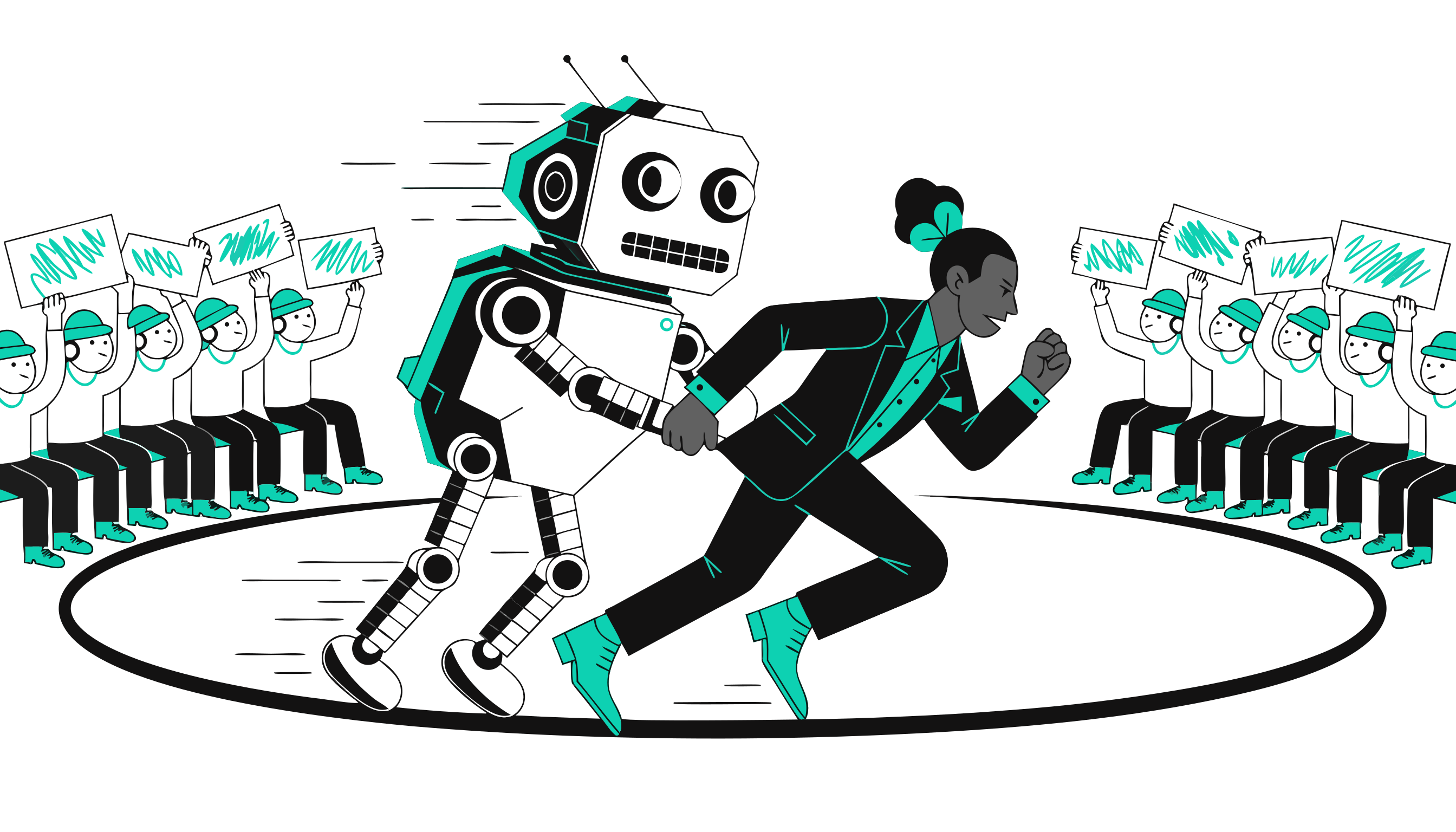
A tech CEO made headlines in August 2025 by laying off nearly 80% of his workforce after employees refused to adopt AI fast enough. Two years in, he said he'd do it again.[1] The story ran everywhere as a bold leadership move. Nobody asked the more important question: why were the employees refusing in the first place?
That gap—between solving the symptom and solving the cause—is where most AI transformations die.
A 2026 Fortune report found that 80% of white-collar workers are now actively rejecting mandated AI adoption, a phenomenon researchers have started calling FOBO: Fear of Becoming Obsolete.[2] A survey of 2,400 knowledge workers found that 29% admit to actively sabotaging their company's AI strategy—44% among Gen Z employees.[7] These aren't Luddites. They're educated, high-performing people who've correctly interpreted what most mandates actually communicate: AI is coming for your job, and if you don't help it arrive faster, you'll be first to go. Then their employers are surprised when they resist.
The core mistake: treating AI transformation as a technology deployment problem when it is a human behavior change problem. BCG spent years studying what separates the organizations that see genuine ROI from the vast majority that don't—and arrived at a principle that upends most transformation budgets. But first: why does AI-first feel so rational to the people setting the strategy?
Key Takeaways
- ✓
80% of white-collar workers are rejecting AI mandates—not because they oppose AI, but because mandates signal threat rather than opportunity
- ✓
BCG's 10-20-70 principle shows 70% of AI transformation value comes from people, processes, and culture—the dimension most organizations invest in last
- ✓
Forcing adoption through metrics and mandates creates compliance theater: surface usage that generates false-positive signals while genuine transformation stalls
- ✓
Technical and non-technical tool adoption require completely different strategies—what works for engineering teams actively backfires with operations, finance, and legal
- ✓
Enablement infrastructure—prompt libraries, AI champions, internal RAG systems, role-specific playbooks—is the unsexy work that determines whether tool investment pays off
- ✓
Organizational structure matters: siloed AI centers of excellence consistently underperform embedded team models for sustained adoption
- ✓
90% of AI PoCs die before production. The five design principles that separate durable tooling from temporary demos are abstraction, observability, graceful degradation, evaluation infrastructure, and model-agnostic interfaces
- ✓
Every change-management shortcut accumulates adoption debt that costs roughly 2x more to remedy after a failed deployment than the original people-work would have required
Why AI-First Feels Logical (Until It Doesn't)
The incentive structures that push organizations toward the wrong sequence.
Leadership doesn't choose AI-first because they don't care about people. They choose it because every incentive structure points that way.
AI tooling is purchasable, demonstrable, and shows up as a line item. You can hand the board a number—enterprise licenses, integrations deployed, compute spend, demo screenshots. People readiness—the deliberate work of helping hundreds of employees change how they think about their jobs—is slow, messy, and doesn't generate a slide-deck metric.
The competitive pressure argument compounds this. When your CFO presents a deck showing competitors deploying AI across four business units, 'let's spend three months building psychological safety' is not a compelling counter-move. The urgency is real. The competitive threat is real. The mistake is assuming that moving faster on technology also speeds up the transformation.
It doesn't. It slows it down.
When organizations treat AI adoption as primarily a technology challenge, they optimize for deployment speed while ignoring the human lag that follows. Tools land. One-time training happens. People comply enough to avoid consequences. The transformation stalls. What leadership eventually reads as an adoption problem was always a sequencing problem—one they introduced themselves.
The Anatomy of a Failed AI Mandate
Why adding more pressure produces the opposite of adoption.
The failure pattern isn't random. It follows a self-reinforcing loop that deteriorates every time leadership tightens the pressure.
It starts with the mandate: use AI, hit these metrics, or face consequences. That announcement does something specific to human psychology—it activates FOBO. Employees read the mandate not as 'AI will help you' but as 'AI is replacing you, and your speed of cooperation is being graded.' This reading is often unintentional on leadership's part. The signal received is nonetheless consistent.
From that threat state, employees divide into two populations. The majority adopt surface behaviors—opening tools, running queries, generating outputs nobody acts on—while changing nothing substantive about how they actually work. Organizational researchers call this compliance theater. The minority resists more openly: vocal pushback, deliberate workarounds, or the active sabotage that a 2026 survey found in roughly 29% of knowledge workers.[7]
The cruel irony: the surface-use majority generates false-positive adoption signals. Leadership sees the usage dashboard, believes the transformation is tracking, and escalates pressure on the resistant minority. More pressure deepens FOBO in both groups. The loop accelerates. The tools accumulate interaction data that bears no relationship to whether anyone's work is actually improving.
The 70% That Decides Everything
BCG's principle explains why most AI transformation budgets are allocated backwards.
BCG spent years studying what separates the small number of organizations that realize genuine financial returns from AI—roughly 5% of companies in their 2025 global study—from the vast majority that don't.[3] Their conclusion became known as the 10-20-70 principle.
Ten percent of AI value comes from the algorithms. Twenty percent from the data and technology infrastructure. The remaining 70% comes from people, processes, and cultural transformation.
Organizations consistently invert this allocation. They spend heavily on models, infrastructure, and integrations, run a training webinar or two, announce the initiative at an all-hands, and wait for results. BCG found that the highest-value adopters share something else: they fundamentally redesign workflows around AI rather than layering AI on top of existing processes.[4] McKinsey's 2025 State of AI survey found that workflow redesign had the single strongest correlation with measurable EBIT impact—stronger than model selection, data quality, and infrastructure investment combined.[6]
You cannot buy the 70%. No vendor installs it. No consultant delivers it in a two-day workshop. It requires deliberate, ongoing work with the people who will actually use the tools every day—work that takes time, requires trust, and looks nothing like a deployment checklist.
This is also why forcing doesn't work: you can mandate tool usage. You cannot mandate workflow redesign. That only happens when people understand and genuinely believe in what's changing.
Tool deployment leads; people readiness follows
Adoption measured by tool usage frequency and activations
Training: one mandatory webinar at launch
Resistance treated as an HR or performance problem
Timeline driven by procurement and integration cycles
Success defined as tools deployed and licensed
People readiness leads; tool deployment follows
Adoption measured by workflow change and outcome improvement
Training: job-specific, ongoing, and peer-led
Resistance treated as a change management signal to diagnose
Timeline driven by behavioral change and trust curves
Success defined as people working measurably differently
What Successful AI Transformations Actually Look Like
Patterns from organizations that got genuine ROI—and what they did differently from the start.
The organizations that emerge with genuine AI-driven competitive advantage share a pattern that looks almost nothing like what most transformation programs describe. They aren't necessarily the fastest movers. They aren't the ones with the biggest AI budgets or the most ambitious announcements. They are, almost without exception, the ones that treated the first six months as infrastructure—not for the technology, but for the people and processes.
Stage 1: Diagnosis before prescription. Successful transformers spend real time—often eight to twelve weeks—understanding where work actually happens and where AI creates genuine leverage before selecting a single tool. They map workflows at the task level, identify the specific steps that are high-volume and low-judgment, and look for where error rates are high and feedback loops are slow. The goal is to find the 20% of work where AI can do 80% of the lifting, rather than deploying broadly and hoping something sticks.
Duolingo's 2023-2025 AI integration is instructive. Rather than announcing an AI transformation, they identified specific content creation bottlenecks—primarily the speed of generating new exercise variations and learner-facing explanations—and built AI tooling targeted at exactly those tasks. Adoption was near-universal within those teams because the tools solved actual, specific pain points rather than generic productivity promises.
Stage 2: Champions before mandates. Every successful transformation we've studied had an identifiable group of early adopters who found genuine value in specific tools for specific tasks—and were then formally empowered to share that learning with peers. These weren't IT evangelists or transformation leads. They were respected practitioners in legal, finance, engineering, customer success, and marketing who figured out something that genuinely made their work better and could explain it in terms their colleagues understood.
The structural insight: champions are discovered, not appointed. Organizations that try to create champions by selecting enthusiastic volunteers and training them as evangelists consistently get worse results than those that find people who already found value and remove barriers to sharing it.
Stage 3: Workflow redesign, not tool overlays. The difference between organizations that see lasting ROI and those that plateau after initial gains is almost always this: did they redesign the workflow, or did they layer AI on top of the existing one? Layering produces modest efficiency gains that erode as the novelty fades. Redesign produces compounding gains that improve as people develop intuition for how to use AI judgment effectively.
A mid-size law firm ran an AI document review tool alongside their existing review process for six months, got marginal gains, and was ready to pull the plug. A consultant pointed out they were asking junior associates to do AI-assisted review exactly as they'd done manual review—same workflow, same checkpoints, same escalation paths. When they redesigned the process with AI handling first-pass document triage and humans focusing entirely on judgment-heavy analysis, throughput improved by over 60% and associate satisfaction went up. Same tool. Different workflow design.
| Dimension | Organizations That Succeeded | Organizations That Stalled |
|---|---|---|
| Starting point | Workflow analysis: where is leverage highest? | Tool evaluation: which vendor wins the RFP? |
| First 90 days | Trust diagnostic, workflow mapping, willing pilot group | Enterprise license negotiation and IT integration |
| Champion model | Discovered from practitioners who found real value | Appointed enthusiasts trained as evangelists |
| Training approach | Role-specific, peer-led, continuous | Vendor-provided webinar at launch |
| Workflow strategy | Redesign workflows around AI capabilities | Layer AI tools onto existing processes |
| Measurement | Outcome metrics: time saved, error rate, quality | Usage metrics: activations, logins, queries |
| Resistance handling | Diagnostic signal: what does resistance tell us? | Performance problem: who is non-compliant? |
| Year 2 trajectory | Compounding gains; each deployment builds on the last | Plateau or decline; each deployment restarts from scratch |
What People-First Actually Looks Like
Not slower. Not softer. Just sequenced correctly.
People-first doesn't mean avoiding urgency or delaying tools indefinitely while building consensus. It means asking the right questions first.
AI-first organizations ask which tools should we deploy? and figure out the people side later. People-first organizations ask what do our people need to believe, know, and be able to do before these tools will create value?—and then choose tools accordingly.
This sequencing difference has real consequences. A financial services firm ran a six-month selection and implementation process for an AI-assisted analysis platform. Adoption was essentially zero eighteen months after launch. Post-mortem revealed that analysts saw AI as a threat to the skilled judgment that justified their compensation—nobody had asked that question before deployment. The tools were well-chosen. The failure was entirely in the framing and sequence.
Three things consistently differentiate people-first deployments: co-design instead of mandate, trust-building before measurement, and job-level specificity instead of org-wide generalization.[5]
Co-design means involving actual users in selecting and configuring tools before rollout—not as beta testers, but as co-authors of how the tools will fit their work. Trust-building before measurement means resisting the temptation to track usage metrics until people have had genuine time to explore without performance pressure. Job-level specificity means replacing 'everyone should use AI' with 'here is exactly how AI improves your specific role, demonstrated by someone doing your job.'
- 1
Run a trust diagnostic before any tool rollout
Ask employees what they believe the AI initiative is primarily designed to accomplish. If more than 30% describe it as cost reduction or headcount reduction, fix the framing before deploying the tools. Narrative gaps are cheaper to close before deployment than after.
- 2
Co-design with skeptical middle adopters, not just enthusiasts
Involve people who are cautious or skeptical—not only the enthusiastic early adopters—in shaping how tools get deployed. Skeptics surface failure modes that believers miss, and their buy-in signals authenticity to the rest of the org.
- 3
Make the first win job-specific and undeniable
Identify one high-visibility, concrete use case per role where AI demonstrably saves time or improves output quality. That proof of value must precede any broader mandate—and must be described in language the role owner would use, not the language of transformation programs.
- 4
Build peer networks before scaling broadly
Identify and formally support AI champions within each team—people who've found genuine value and can translate it for peers without triggering top-down associations. Champions must be respected contributors, not IT liaisons.
- 5
Measure workflow change, not tool usage
Replace click-tracking dashboards with outcome metrics: time saved per task, error rates, employee-reported confidence levels. Define success metrics with affected teams before deployment—misaligned metrics create misaligned behavior.
Technical vs. Non-Technical Tool Adoption: Two Completely Different Games
What works for engineering teams actively backfires with legal, finance, and operations. The dynamics are not variations on a theme—they are fundamentally different problems.
One of the most reliable ways to derail an enterprise AI rollout is to treat technical and non-technical tool adoption as variations on the same challenge. They are not. The resistance patterns are different. The trust-building requirements are different. The workflow integration challenges are different. The definition of a win looks nothing alike.
Technical tool adoption — AI coding assistants, test generation tools, documentation generators, code review agents — tends to hit a specific set of obstacles. Engineers are generally comfortable with probabilistic tools, but deeply skeptical about quality. They've seen "AI" promise the world and deliver plausible-looking garbage. The threshold for genuine adoption is correspondingly high: a coding assistant that produces code they'd actually ship, not code they have to rewrite. The friction is technical quality, not existential threat.
This makes engineering adoption responsive to demonstration. Show a skeptical senior engineer three concrete examples where the tool accelerated something they've been doing slowly for years — writing boilerplate, generating test cases for edge conditions, explaining legacy code they inherited — and the quality bar speaks for itself. The adoption barrier is tool capability, not human psychology. Once the tool clears the quality threshold, adoption follows quickly and doesn't require ongoing management.
GitHub Copilot's rollout data illustrates this: in teams with strong adoption, the primary driver was a specific, demonstrable productivity improvement on a concrete task the engineer did regularly. In teams where adoption was weak, the primary blocker was that engineers didn't find the tool reliable enough for their specific language, codebase structure, or development style. The problem was almost never fear of replacement—it was functional skepticism.
Non-technical tool adoption operates on completely different terrain. When you deploy AI writing tools to a marketing team, AI analysis tools to a finance team, or AI document review to a legal department, the immediate obstacles are rarely about technical quality.
Marketing teams often resist AI writing tools not because the outputs are bad, but because they perceive AI-generated content as professionally threatening to the identity of 'being a good writer'—the skill that got them hired and that they've built their reputation on. The obstacle is identity, not functionality.
Finance teams frequently reject AI analysis tools because their work product is ultimately their professional judgment, and AI-assisted analysis feels like outsourcing that judgment to a system they don't understand and can't fully explain to their CFO. The obstacle is accountability—who is responsible for an AI-assisted recommendation?
Legal teams resist AI document review because any error has asymmetric consequences. The upside of a slightly faster review is modest; the downside of a missed clause is a lawsuit. The obstacle is risk tolerance calibrated to the consequences of failure in that specific role.
Understanding these role-specific resistance patterns before deployment—not after—is the work that determines whether the adoption program lands or creates a FOBO spiral.
| Role | Tool Category | Primary Barrier | Effective Unlock | Anti-Pattern |
|---|---|---|---|---|
| Engineering | AI coding assistants (Copilot, Cursor) | Output quality below trust threshold | Demo on their actual codebase and language | Mandating use before quality is established |
| DevOps / Platform | AI ops, incident analysis, runbook generation | Integration complexity + on-call risk aversion | Introduce in low-stakes postmortem analysis first | Requiring AI for production incident response immediately |
| Marketing / Content | AI writing, content generation, SEO tools | Professional identity: 'I'm a writer, not a prompt engineer' | Frame as amplification of their creative judgment, not replacement | Measuring output volume per person after AI deployment |
| Finance / FP&A | AI analysis, forecasting, anomaly detection | Accountability gap: who owns an AI-assisted recommendation? | Build audit trails; AI surfaces options, human approves | Deploying without a documented decision framework for AI outputs |
| Legal / Compliance | Document review, contract analysis, research | Asymmetric risk: errors have severe downside | Start with low-stakes pre-screening, prove accuracy over time | Deploying in high-stakes workflows before accuracy is validated |
| Customer Success | AI response drafting, sentiment analysis, ticket routing | Relationship authenticity: 'Customers can tell it's AI' | Use AI for draft + context; human makes final call on tone | Fully automated responses without human review gate |
| HR / People Ops | Resume screening, policy Q&A, performance analysis | Bias perception + regulatory exposure (EEOC, GDPR) | Start with non-hiring use cases; build bias audit infrastructure first | Using AI in hiring workflows before completing bias assessment |
Building the Enablement Layer: The Unsexy Work That Determines ROI
Prompt libraries, AI champions programs, role-specific playbooks, and internal RAG systems—the infrastructure nobody budgets for and everyone needs.
There's a category of AI investment that almost never appears in transformation budgets and almost always determines whether tool investments pay off. Call it the enablement layer: the infrastructure that sits between 'we deployed the tools' and 'people are actually using them well.'
The enablement layer is not exciting. It doesn't generate demo-worthy moments. You can't present it to a board as a competitive advantage announcement. But the organizations that build it consistently generate 2-3x higher adoption rates and measurably better outcomes than those that rely on tool vendors to drive adoption through onboarding materials and in-product tutorials.
Prompt libraries and playbooks. Raw AI access without scaffolding produces wildly inconsistent quality. When 200 people are all trying to figure out how to use the same tool independently, they reinvent the same prompts, make the same mistakes, and conclude that the tool isn't reliable when their inconsistent prompting is producing inconsistent results. A prompt library—curated, role-specific collections of prompts that are known to work for the specific tasks people actually do—immediately raises the floor on output quality and dramatically reduces the activation energy to get started.
A good prompt library is not a generic collection of 'helpful prompts.' It is organized by role and task, linked to specific workflows, includes examples of good outputs alongside the prompts that produced them, and is maintained as a living resource that evolves as the tools and team knowledge improve. The difference between a generic prompt library and a role-specific one mirrors the difference between a general-purpose textbook and a job-specific training manual.
AI champions programs. As discussed earlier, champions are discovered rather than appointed. But once discovered, they need formal infrastructure: protected time for peer education, a channel to connect with champions across teams, recognition that this is real work rather than an add-on to their day job, and a feedback loop back into tool and playbook improvement.
The most effective champions programs share three features. First, champions spend at most 20% of their time on champion activities—they remain practitioners with credibility, not full-time evangelists with none. Second, they have a direct channel to the team responsible for tooling decisions—their field observations are how you learn what's actually blocking adoption. Third, they're connected to each other across teams so patterns compound rather than staying siloed.
Internal RAG and knowledge management. AI tools that only access general world knowledge plateau quickly. The second-order value—and the durable competitive advantage—comes from AI tools that can access your organization's specific knowledge: past projects, institutional memory, internal policies, customer context, product documentation, and proprietary research.
Building internal retrieval-augmented generation (RAG) systems is more complex than deploying off-the-shelf tools, but the ROI is categorically different. A junior analyst with access to an AI tool that draws on seven years of internal research and client case studies performs at a level that previously required years of institutional knowledge accumulation. This is where AI stops being a productivity tool and starts being a capability multiplier.
AI literacy programs by function. Generic 'AI literacy' is not useful at the role level. A finance professional needs to understand how to evaluate AI-generated financial models, recognize common hallucination patterns in quantitative analysis, and know where to apply healthy skepticism to AI outputs in their specific workflow. A legal professional needs entirely different AI literacy than a product manager. The investment in function-specific AI literacy—separate curriculum for each major role family—is substantial but pays off in the quality and durability of adoption.
- 1
Build role-specific prompt libraries before broad rollout
Curate prompts for the 10 most common tasks in each major role family. Include worked examples showing the prompt, the output, and why the output is good. Host in a shared, searchable location—not a PDF attached to an email that gets lost after week one.
- 2
Stand up an AI champions network with formal infrastructure
Identify one champion per team of 10-15 people. Protect 15-20% of their time for champion activities. Create a dedicated channel for cross-team learning. Make their contributions visible and valued—champions who feel invisible stop contributing.
- 3
Invest in internal knowledge infrastructure before advanced AI tools
Off-the-shelf AI without access to internal knowledge produces generic results. Before deploying advanced AI workflows, invest in the knowledge infrastructure: document storage with metadata, retrieval pipelines, and curation practices that make internal knowledge findable and usable by AI systems.
- 4
Create function-specific AI literacy curricula
One generic AI literacy program serves no function well. Develop separate curricula for each major role family: finance, legal, engineering, marketing, operations. Each curriculum should cover: how AI makes mistakes in this function's specific work, how to verify outputs, and how to integrate AI assistance without creating accountability gaps.
Organizational and Structural Changes That Enable Sustained Adoption
Siloed AI centers of excellence consistently underperform. The structural changes that actually move the needle are less glamorous and more fundamental.
Organizational structure is not a soft concern—it is one of the most concrete determinants of whether AI adoption compounds or plateaus. The structural decisions made in months one through six tend to lock in the trajectory for the next two to three years.
The AI Center of Excellence trap. The most common structural response to an AI transformation mandate is to create an AI Center of Excellence (CoE): a centralized team of AI specialists, data scientists, and transformation leads who own the AI strategy and drive adoption across the organization.
CoEs solve a real problem—they concentrate expertise that most business units don't have and provide central coordination for tooling decisions. But they introduce a structural problem that consistently undermines the adoption they're supposed to accelerate: they create an organizational separation between the people with AI expertise and the people who need to actually change how they work.
When AI expertise lives in a separate team, business units learn to treat AI as a service they request rather than a capability they develop. The CoE becomes a bottleneck. AI initiatives require CoE engagement. The CoE has finite capacity. The business units with the most political capital get served first. Everyone else waits, grows frustrated, and develops a mental model of AI transformation as something that happens to other departments.
The embedded model. The structural pattern that consistently outperforms the CoE model is distributed AI expertise embedded directly in business functions, with a small central platform team that builds and maintains the shared infrastructure those embedded teams use.
This model looks like: one or two AI-fluent practitioners embedded in each major business function—engineering, finance, legal, marketing, operations—who are full members of that function, fluent in its workflows and language, and responsible for identifying and building AI applications specific to that function's needs. A small central team (four to eight people in a mid-size organization) owns the underlying platform: the models, the retrieval infrastructure, the evaluation framework, the security and governance policies.
The embedded model distributes the 70%—the people, process, and culture work—across every function rather than concentrating it in a team that has to influence from outside. Business functions develop genuine AI capabilities rather than AI service dependency. The compounding effect is real: each function's embedded practitioners build on each other's work, and the adoption curve accelerates rather than plateauing.
Role evolution by function. Sustained AI adoption requires every major role to evolve, not just the technical ones. The organizations that navigate this well are explicit about what changes in each role and provide genuine pathways for people to develop the new capabilities, rather than announcing the change and expecting people to self-direct their own evolution.
For individual contributors: AI literacy specific to their function becomes a standard competency. The work shifts from execution of process-following tasks to judgment-exercising tasks that AI cannot reliably perform. People who build this capability become more valuable. The organizations that succeed are explicit that this is the direction of travel—not in a threatening way, but as a genuine investment in career development.
For managers: the management function shifts from coordinating task execution to developing AI-augmented judgment in their teams. Managers need to understand how to evaluate AI-assisted work, how to provide meaningful feedback on AI use quality (not just output quality), and how to design workflows that leverage AI while preserving human accountability where it matters.
AI expertise concentrated in one team
Business units request AI capabilities as a service
CoE becomes adoption bottleneck at scale
Business functions develop AI service dependency
Adoption plateaus when CoE capacity is exhausted
Cultural change happens to business units, not with them
AI expertise distributed in every major function
Business units build AI capabilities directly
Small central team owns shared platform infrastructure
Each function develops genuine AI capability
Adoption compounds as embedded practitioners share learning
Cultural change driven from within each function
| Function | What Changes in the Role | New Capability Required | Career Path Signal |
|---|---|---|---|
| Engineering | Less time on boilerplate; more on system design and AI-assisted architecture | Prompt engineering, AI code review skills, agent orchestration | Senior engineers who can direct AI tools effectively become force multipliers |
| Finance / FP&A | Less time on data assembly and formatting; more on scenario judgment | AI output validation, model assumption auditing, accountability documentation | Analysts who develop AI evaluation skills move faster on the judgment curve |
| Legal | Less time on first-pass document review; more on judgment and strategy | AI accuracy assessment in legal contexts, bias detection, responsible use governance | Associates who build AI-augmented research skills increase throughput without sacrificing quality |
| Marketing | Less time on drafting and formatting; more on strategy and positioning | AI content quality judgment, brand voice guidance for AI tools, output curation | Strategists who can direct AI content production at scale become higher-leverage |
| HR / People Ops | Less time on policy lookups and routing; more on complex case judgment | Bias auditing for AI HR tools, responsible use policy for employee-facing AI | HR business partners who understand AI limitations in people decisions are critical compliance assets |
| Management | Less time on task coordination; more on judgment development and AI work quality | Evaluating AI-assisted work, coaching AI use quality, designing AI-augmented workflows | Managers who develop AI-fluent teams become the most valuable leadership layer |
Building Foundational AI Tooling That Survives PoC Phases
90% of AI proofs of concept never reach production. The design principles that separate demos from durable systems.
There is a graveyard behind every successful enterprise AI deployment. It contains the previous attempts—the PoCs that worked beautifully in demo conditions and died quietly before reaching production, the pilots that ran for three months and were quietly discontinued, the innovations that were celebrated in the all-hands and never heard from again.
Industry estimates suggest that 85-90% of enterprise AI PoCs never make it to production. The mortality causes are remarkably consistent, and most have nothing to do with the quality of the underlying AI.
The PoC graveyard: why promising demos die. The most common cause of PoC death is not AI failure—it's integration failure. A PoC built on direct API calls to a single vendor's model works until that model is updated, deprecated, or until the security team reviews the data flow and raises concerns. A PoC that was built over a curated demo dataset works until someone asks it to run over messy production data. A PoC that assumed a fixed prompt template works until the use case evolves and the template no longer fits.
The second-most-common cause is operational failure: the PoC was built by a small, specialized team that no longer owns it, there's no monitoring infrastructure to detect quality degradation, there's no feedback loop to improve the system over time, and the first production incident exposes the fact that nobody actually owns this thing.
The third cause—increasingly important as AI systems multiply—is evaluation failure: there's no systematic way to know whether the system is performing well, and the first sign that something is wrong is a user complaint or a business impact rather than a monitoring alert. By that point, organizational trust in AI systems has taken a hit that takes months to recover from.
Building tooling that survives is fundamentally about building for the second year, not the demo. The five design principles below aren't academic—they're derived from the common failure modes that kill PoCs, and each one directly addresses a specific mortality cause.
- 1
Principle 1: Abstraction over vendor
Never build directly against a specific model's API in production systems. Build against an abstraction layer that lets you swap models without changing application code. This is not premature optimization—it is the single most important design decision for system longevity in a rapidly evolving model landscape.
- 2
Principle 2: Observability from day one
Every LLM call in production should be logged, traced, and measurable from the moment it ships. If you can't tell whether the system's quality is degrading after a model update, you will find out from a user complaint rather than a monitoring alert. By then, the organizational trust damage is already done.
- 3
Principle 3: Evaluation infrastructure before scale
Build a suite of automated evaluations for your system's core behaviors before it handles significant production volume. Evaluations are how you know when a model update broke something before your users do. They are also how you validate that a new model performs better than the current one before you make the switch.
- 4
Principle 4: Graceful degradation
Design every AI-dependent workflow to function—perhaps less efficiently, but functionally—if the AI component fails, degrades, or produces low-confidence output. Systems that fail silently or catastrophically when the model misbehaves destroy organizational trust in AI far more efficiently than systems that fail gracefully and explicitly.
- 5
Principle 5: Ownership and feedback loops
Every production AI system needs a clear owner—a person or team responsible for its quality over time, empowered to update it, and accountable for what it does. Systems without clear ownership degrade silently until they fail loudly. Ownership requires: a feedback loop from users to system improvement, a process for incorporating that feedback, and the authority to evolve the system as use cases and model capabilities change.
| Design Principle | PoC-Level Signal | Production-Ready Signal | Common Failure Mode Prevented |
|---|---|---|---|
| Abstraction | API calls go through an interface, not directly to vendor SDK | Swapping the model requires changing one adapter file, not business logic | Model deprecation or breaking API change forces rewrite |
| Observability | Every LLM call logs input/output/latency | Quality trend dashboards exist; alerts fire before users notice degradation | Silent quality degradation discovered via user complaint |
| Evaluation | Golden dataset of 20-50 test cases exists | Eval suite runs automatically on every deployment; thresholds gate promotion | Model update ships that breaks system behavior undetected |
| Graceful degradation | System handles API failures without crashing | Low-confidence outputs are surfaced explicitly; fallback path is tested | User-facing error from AI failure destroys trust |
| Ownership | Named individual owns the system's quality | Review cadence exists; feedback loop from users to system improvement documented | System degrades silently as model and use case evolve; nobody acts |
Building for the Innovation Cycle: Staying Ahead Without Chasing Every Shiny Object
AI capabilities are evolving faster than any organization can track. The practices that separate resilient AI programs from ones that feel permanently behind.
The AI landscape has a particular property that makes organizational strategy unusually hard: it moves fast enough that decisions made eighteen months ago are routinely obsolete, but slow enough that organizations feel constant pressure to chase each new development rather than building durable foundations.
The result is a pattern that appears in almost every large organization's AI journey: a series of pivots, each chasing the latest capability, with limited compounding because the underlying infrastructure gets rebuilt each time. The organizations that look behind at the end of two years often find that they've built three or four systems addressing the same use cases, none of them production-grade, all of them showing promising results in demo conditions.
The 18-month obsolescence problem. Most enterprise AI projects have an effective shelf life of 12-18 months before a meaningful capability shift makes the current approach look outdated. This isn't a reason to avoid building—it's a reason to build differently. Systems built with the abstraction, observability, and evaluation infrastructure described in the previous section upgrade gracefully as model capabilities improve. Systems built as direct API integrations get rebuilt from scratch.
The critical insight: the infrastructure investment pays off across model generations, not just for the current model. Every evaluation you write for the current system is an asset you use to evaluate the next model. Every abstraction layer is infrastructure you don't rebuild. Every observability pipeline tells you whether the new model is actually better for your use case before you commit to it.
Evaluation-first model selection. The organizations that navigate model transitions most effectively share a practice that sounds obvious and is almost universally neglected: they evaluate new models on their actual use cases before making adoption decisions, using the evaluation infrastructure they've already built.
This sounds obvious because it is. But the default in most organizations is that model adoption decisions are made based on benchmark comparisons, vendor presentations, and the opinions of AI enthusiasts who tried the new model on their personal projects. None of these predict performance on your specific use cases with your specific data and prompting patterns.
A financial services firm evaluating a major model upgrade ran their full evaluation suite—forty automated tests covering their core use cases—against the new model before any production consideration. Sixteen of forty tests showed meaningful improvement. Eight showed regression. The regression cases were their highest-stakes workflows. They updated the specific prompt patterns causing the regressions before upgrading production. The upgrade shipped without incident. The organizations that didn't do this discovered the regressions when users started complaining.
Avoiding vendor lock-in without sacrificing depth. The abstraction layer prevents technical lock-in, but there's a subtler form of lock-in that abstraction doesn't address: capability lock-in, where an organization's workflows are designed around a specific model's particular strengths or quirks. When that model is deprecated or a better one emerges, the workflows need rethinking even if the code can adapt.
The practice that addresses capability lock-in is prompt design with documented assumptions: for every production prompt, document what capabilities you're relying on, what the known limitations are, and what the fallback behavior is when those capabilities aren't available. This documentation turns a prompt from a black-box incantation into a specification that can be evaluated, updated, and migrated.
The research-to-practice pipeline. AI research publishes faster than enterprise organizations can absorb. The organizations that stay current without chasing every development have a deliberate pipeline: a small team (often the central platform team) that monitors research, filters for production relevance, builds internal proof-of-concept tests on promising techniques, and promotes to the embedded practitioners when something has demonstrated production-grade value.
The filter criteria matter: promising in research is not the same as ready for production. The questions that matter are whether the technique works reliably on messy real-world data, whether it requires infrastructure the organization doesn't have, and whether the incremental gain justifies the implementation cost at this stage. Applying these filters consistently prevents the chasing-shiny-objects pattern while keeping the organization's capability current.
- 1
Build model-agnostic evaluation infrastructure before adopting new models
Your evaluation suite is your primary tool for navigating model transitions. Before any new model enters production consideration, it must pass your existing evaluation suite. This discipline prevents regressions, catches unexpected failure modes, and gives you an evidence-based rather than benchmark-based adoption decision.
- 2
Document prompt assumptions alongside every production prompt
Every production prompt should have associated documentation: what capabilities it relies on, what the known limitations are, and what the expected behavior is on edge cases. This transforms prompts from incantations into specifications that can be reviewed, updated, and migrated when the model changes.
- 3
Establish a research-to-practice pipeline with production relevance filters
Designate a small group (2-4 people in the central platform team) responsible for monitoring AI research and vendor developments. Create explicit filters for production relevance: does this technique work on real-world messy data? Does it require infrastructure we don't have? Is the incremental gain worth the migration cost at this stage?
Adoption Debt: The Hidden Cost of Forcing
Every change-management shortcut creates compounding cost that must eventually be paid.
The analogy to technical debt is instructive. Individual shortcuts feel reasonable in the moment and compound over time. The cost of addressing them later reliably exceeds what the original careful work would have required.
Forcing a mandate instead of earning genuine understanding creates adoption debt. Measuring tool activations instead of workflow change creates adoption debt. Skipping co-design because the timeline is tight creates adoption debt.
The payment arrives slowly, then all at once. It shows in AI investments that don't compound—where each new tool deployment requires the same re-education as the first, because no organizational capability for adoption was ever built. It shows in high-performing employees who leave rather than adapt under threat conditions. It shows in leadership's growing distrust of AI spending, because usage dashboards look healthy while business outcomes remain flat.
One enterprise software company, eighteen months into a tool-first AI transformation program, discovered that closing the adoption gap required roughly twice the original tool cost in retraining, reframing, and rebuilding organizational trust. The shortcuts taken in months two through six were the most expensive decisions in the entire program. At the time, nobody recognized them as decisions—they called them pragmatic trade-offs under timeline pressure.
Technical adoption debt compounds with human adoption debt. Organizations that skipped the enablement layer find that each new tool deployment requires building that layer from scratch—or deploying into the same resistance they encountered with the first tool. Organizations that built enablement infrastructure find that each subsequent deployment is faster, cheaper, and more widely adopted, because the muscles are already developed and the trust has already been earned.
| Dimension | Forced Adoption | People-First Adoption |
|---|---|---|
| Time to genuine workflow change | 12–24 months (if at all) | 6–12 months |
| Resistance encountered | High — active sabotage in ~30% of cases | Low — resistance diagnosed before deployment |
| Adoption debt accumulated | High — compounds with each new tool | Low — capability builds with each deployment |
| False-positive adoption signals | Common — usage metrics overstate reality | Rare — metrics are aligned with outcomes |
| Employee attrition risk | Elevated — threat conditions accelerate departure | Low — trust conditions support retention |
| Value compounding over time | Flat or declining | Accelerating — each win enables the next |
| Enablement infrastructure | Absent — each tool deployment starts from scratch | Cumulative — prompt libraries and champions compound |
| PoC-to-production rate | Low — tooling built without durability principles | Higher — abstraction and observability from day one |
Recovering from a Failed Mandate
What to do when the transformation has already gone AI-first.
If your transformation has already taken the AI-first route and you're seeing the symptoms—flat outcomes despite strong usage metrics, vocal pockets of resistance, a widening gap between reported adoption and actual productivity—recovery is possible. It is not fast, and it requires naming the real problem correctly.
Don't frame it as 'we need better change management.' Frame it as 'we created conditions that made people distrust this initiative, and we need to rebuild that trust explicitly.' The difference matters. The first framing treats employees as the problem. The second treats the organization's approach as the problem—which is accurate, and which people can hear without becoming defensive.
Three practical recovery moves for the human layer. First, stop measuring activity and start measuring outcomes—ask employees where AI is genuinely saving them time or improving their work quality, instead of tracking sessions and clicks. Second, create formal retrospective channels where employees can describe what's broken about the current tools or rollout, without fear of performance consequences. This surfaces the real blockers and signals that leadership is listening. Third, find the quiet wins—people who've genuinely integrated AI into specific tasks in ways that made those tasks better—and amplify their stories through peer channels rather than another leadership announcement about transformation milestones.
For the technical layer, recovery looks different. Audit the existing AI systems for the five survivability principles: do they have abstraction layers? Is there observability infrastructure? Are there evaluations? Who owns each system? The audit will typically reveal a portfolio of direct API integrations with no monitoring, no evaluations, and unclear ownership—a single model update away from a production incident. Prioritize adding observability and evaluation infrastructure to the highest-risk, highest-value systems before touching anything else. Don't rebuild—instrument. Add monitoring to what exists. Write evaluations for the behaviors that matter. Assign explicit owners. This is faster than rebuilding and prevents the next incident.
Trust, once eroded, takes longer to rebuild than to destroy. That's not a reason to avoid the work.
People-First AI Transformation Signals
Employees can describe what they personally gain from AI adoption—not just what the company gains
Training is job-specific and includes peer guidance, not only vendor-provided materials
The primary adoption metric is workflow improvement, not tool usage frequency
Leadership has explicitly asked what employees are afraid of and addressed it directly
Resistance is analyzed as change management feedback rather than treated as a performance issue
At least one meaningful workflow has been redesigned around AI, not just had AI layered on top of it
Early adopters were co-designers of the rollout, not merely selected as pilot participants
An AI champions network exists with protected time and cross-team connection
Role-specific prompt libraries exist and are maintained as living resources
Every production AI system has an owner, observability, and at least a basic evaluation suite
AI tools are deployed behind abstraction layers that allow model swapping without business logic changes
The organization has a clear model for how AI expertise is distributed (CoE vs. embedded) and why
Where People-First Reaches Its Limits
People-first transformation is not a universal fix. Some AI failures are genuinely technical—wrong model choice, inadequate data quality, broken infrastructure. People readiness doesn't repair a flawed pipeline. The approach also requires people with real change management competency to execute; not every organization has that capacity, and building it has its own lead time. For organizations under acute existential competitive pressure, the timeline of a well-sequenced people-first program may not align with business realities. In those cases, the tradeoff between adoption debt and competitive positioning is a real decision—not a failure of will, but a genuine constraint that deserves honest acknowledgment rather than pretending the shortcut doesn't cost anything.
Isn't a people-first approach just a slower AI-first approach?
No. People-first changes the sequence, not the pace. The setup phase takes longer—you're diagnosing readiness, co-designing, and building trust before deploying widely. But the scale phase is dramatically faster because you're not fighting resistance the whole way. Organizations that front-load the people work consistently reach genuine adoption faster than those who deploy broadly first and manage resistance afterward.
How do you handle employees who resist regardless of approach?
Distinguish between two types: employees skeptical of how AI is being introduced (a change management problem, fixable with the right approach) and employees categorically opposed to AI (a talent alignment conversation). The majority of resistance is the former. People-first methodology handles it well. The latter requires honest career conversations, not better tooling. Conflating the two—treating all resistance as categorical opposition—is one of the most common and expensive mistakes in failed mandates.
What does a trust diagnostic actually look like in practice?
Three anonymous questions before any tool rollout: 'What do you believe this AI initiative is primarily designed to accomplish?' 'What concerns you most about it?' 'What would make you want to use these tools?' Run it per team, not just org-wide—resistance patterns are rarely uniform across functions. The answers tell you which narratives need to be addressed before you hand people the software. The whole diagnostic takes one week to run and can save eighteen months of remediation.
How do you make the case for a people-first sequence when the board is pushing for faster deployment?
Don't frame it as slowing down. Frame it as front-loading the work that determines whether the investment pays off. Show the adoption debt math: every dollar saved on change management now costs approximately two dollars to recover after a failed deployment. The board cares about ROI. People-readiness investment is ROI insurance—and it is considerably cheaper than fixing a transformation that's gone sideways at scale.
We're 12 months into an AI-first rollout and adoption is flat. Is it too late to pivot?
No. Stop measuring activity, start measuring outcomes. Create retrospective channels with actual psychological safety. Find the quiet wins and amplify them through peer networks rather than leadership announcements. Explicitly name the trust deficit as a leadership responsibility, not an employee problem. For the technical layer, audit existing systems for observability and evaluation gaps before building anything new. Recovery takes roughly half the time of the original failed rollout—painful, but faster than persisting with an approach that demonstrably isn't working.
Should we build an AI Center of Excellence or embed AI practitioners in business units?
The evidence strongly favors the embedded model for sustained adoption. A small central platform team (4-8 people) owns shared infrastructure: models, retrieval systems, evaluation frameworks, governance, and security. AI-fluent practitioners embedded in each major business function own application development and adoption within their function. The CoE model consistently becomes a bottleneck and creates AI service dependency in business units rather than AI capability. Start with a lightweight CoE if you have no existing AI infrastructure, but design toward the embedded model from day one.
Why do 90% of AI PoCs die before production, and how do you prevent it?
The failure modes are remarkably consistent: integration failure (built directly on vendor APIs with no abstraction layer), operational failure (no monitoring, unclear ownership, untested failure paths), and evaluation failure (no systematic way to detect quality degradation before users notice). The five principles that address these: abstraction over vendor, observability from day one, evaluation infrastructure before scale, graceful degradation design, and explicit ownership with feedback loops. Apply all five before the PoC, not after it proves out in demo conditions.
How do we keep up with the pace of AI model and tool development without constantly rebuilding?
The abstraction and evaluation infrastructure you build today pays dividends across every future model generation. Abstraction lets you swap models without touching business logic. Evaluation lets you assess new models against your actual use cases automatically. Together, they transform model transitions from multi-week engineering projects into multi-day validation exercises. Additionally, build a research-to-practice pipeline: a small group that monitors developments and applies production relevance filters before any technique reaches embedded practitioners. This prevents chasing shiny objects while keeping organizational capability current.
- [1]Fortune — This CEO laid off nearly 80% of his staff because they refused to adopt AI fast enough. 2 years later, he says he'd do it again(fortune.com)↩
- [2]Fortune — White-collar workers are quietly rebelling against AI as 80% outright refuse adoption mandates(fortune.com)↩
- [3]Boston Consulting Group — From Potential to Profit: Closing the AI Impact Gap(bcg.com)↩
- [4]Boston Consulting Group — AI Transformation Is a Workforce Transformation(bcg.com)↩
- [5]Prosci — AI Adoption: Driving Change With a People-First Approach(prosci.com)↩
- [6]Harvard Business Review — Overcoming the Organizational Barriers to AI Adoption(hbr.org)↩
- [7]EQ4C Tools — The Corporate AI Mandate: Why Forcing Workers to Adopt AI or Face Termination is Backfiring(tools.eq4c.com)↩
- [8]Medium / Newsbusinesses — The Quiet Rebellion: Why 80% of White-Collar Workers Are Rejecting Mandated AI Adoption(medium.com)↩