All pieces
Data, Context & Knowledge
The Model Works. The ROI Doesn't. Here's the Structural Cause.
AI ROI stalls when data quality is measured in null rates instead of decision outcomes. The five-layer causal map and accountability bridge connecting data governance to business outcome ownership — so quality failures have a named owner and a dollar cost before the quarterly review.
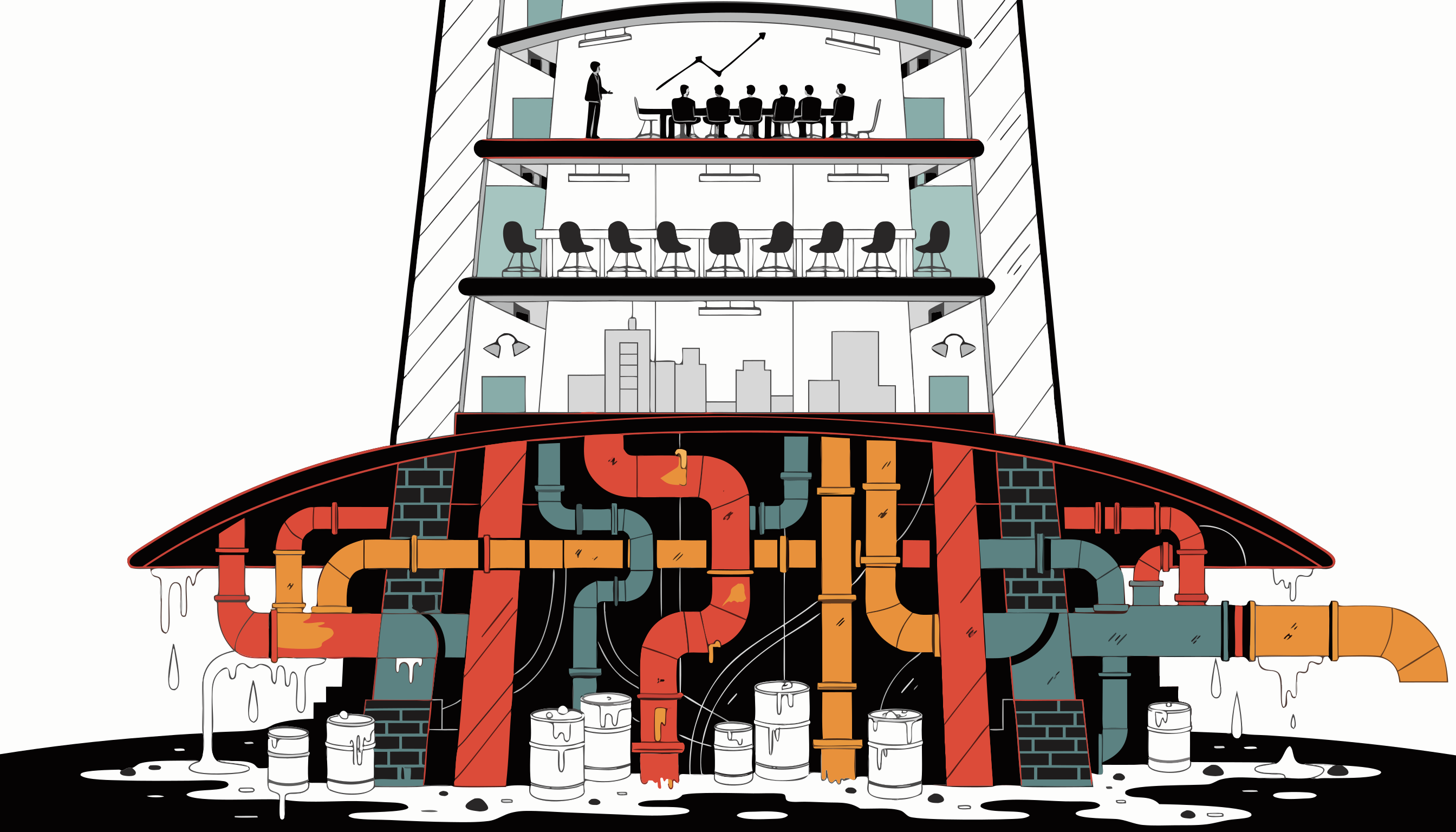

Bain surveyed 951 global companies in 2026. Of those targeting cost reductions of 11–20% from AI, nearly 40% measured outcomes in the 0–10% bucket instead.[1] The technology worked. The value did not arrive. And 90% of those same organizations are now increasing their AI budgets again.
The explanation that does not get said aloud in the board meeting: data access and integration is the single biggest barrier to AI progress, cited by 41% of respondents in the same survey — above compliance concerns, budget constraints, skills gaps, and executive buy-in.[1] The problem is not model capability. It is the infrastructure feeding the model.
Here is the form that dysfunction takes at scale: a Lebow/Precisely survey of 505 data and analytics leaders found that 88% of organizations claim to have AI-ready data infrastructure.[2] Forty-three percent of those same leaders cite data readiness as their top obstacle.[2] That is not cognitive dissonance. It is a measurement failure. "Ready" means the pipeline runs. It does not mean the data quality SLA maps to the specific decision the model feeds — and that decision maps to a named, measurable business outcome.
Sixty-nine percent of enterprise AI leaders struggle to connect AI performance to business outcomes, even as 71% claim their programs align with business goals.[2] That 40-point gap is where the accountability failure lives. The outcomes are not unmeasurable. They are unmeasured, because nobody built the causal chain from data quality contract to business outcome owner.
This article maps that chain — and the ownership structure that makes it operational.
41%
Cite data access as the single biggest barrier to AI progress
Above compliance, budget, skills gaps, and executive buy-in. Bain, 951 global companies, June 2026 [1]
10.3x
ROI gap between strong and poor data integration — with no model difference
Strong data integration: 10.3x AI ROI. Poor data connectivity: 3.7x. The gap is governance structure, not compute. Folio3/Gartner, 2025–2026 [7]
69%
Of AI leaders cannot connect AI performance to a business outcome metric
Despite 71% claiming AI is aligned with business goals. The gap is measurement structure, not intent. Lebow/Precisely, 2026 [2]
88% Confident, 43% Blocked: This Is a Measurement Failure
When readiness and obstacles refer to different standards, governance programs fix the wrong layer.
The confidence-obstacle paradox in the Precisely data is the most useful diagnostic in recent AI survey research. The natural interpretation — that enterprise leaders are overconfident — misses what is actually wrong.
"Ready" means different things to different functions. To the data team: the pipeline runs, the schema is documented, the database is accessible. To the business owner: the data is accurate enough for the specific decision being made, fresh enough that the output is actionable, and structured consistently enough that the model output can be traced back to the input that drove it. These are not the same standard. An engineering team passes the first definition and fails the second entirely, and both sides will report the data is fine.
Gartner stated this precisely in February 2025: "Organizations that fail to realize the vast differences between AI-ready data requirements and traditional data management will endanger the success of their AI efforts."[6] Traditional data quality — the null-rate dashboard, the pipeline CI check, the schema version — was designed for analytics workloads that tolerate stale or inconsistent data because a human reviews the output. AI systems acting on that data often do not have a human in the loop. The quality standard is different, and most data teams are measuring to the old one.
Seventy-one percent of leaders say AI is aligned with business goals; only 31% have metrics tied to KPIs.[2] That 40-point gap is structural: nobody built the mechanism connecting a data quality failure to a business outcome degradation in real time — before the quarterly review where the gap becomes undeniable.
IT Hygiene Standard
Quality measured as null rate, schema compliance, pipeline freshness lag
Pipeline passes CI check — engineering team marks it done
Quality incidents escalated as infrastructure tickets to the data team
Outcome gap diagnosed as a model problem requiring retraining
Success defined as: the system is running without errors
Business Accountability Standard
Quality measured as decision-accuracy degradation for a named outcome metric
Pipeline runs AND the freshness SLA maps to the decision cycle of the consuming team
Quality failures carry a named owner, an estimated dollar exposure, and a response runbook
Outcome gap traced through the causal chain to find the data layer it originated in
Success defined as: the model produces decisions that measurably shift a business metric
Where the Chain Breaks: Five Compounding Failure Points
Each link is independently fixable — but fixing one while ignoring the others just moves the bottleneck downstream.
RAND's 2024 analysis of 65 practitioner interviews identified data quality limitations as one of the five primary causes of AI failure — but practitioners who traced failures past the first diagnosis found the pattern more disturbing: bad data does not fail loudly.[3] It propagates. Each transformation amplifies the inconsistency, and by the time it reaches the business outcome layer, the source is invisible.
The chain has five failure points. A data quality improvement program that addresses only the first two is not a governance program — it is a pipeline optimization that leaves the accountability gap intact.
Link 1: Data silos with no canonical definition. When "purchase date" means one thing in the CRM, another in the data warehouse, and a third in the reporting layer, feature engineering encodes the ambiguity. That ambiguity is invisible to the model. It trains on whatever the feature engineer chose, and that choice is never written down.
Link 2: Feature engineering against inconsistent signals. Features built on ambiguous source data inherit the inconsistency. The model's training distribution does not match production reality. This is not a model problem. The model is behaving correctly — against the wrong input.
Link 3: Model outputs unreliable at the decision boundary. The model returns a confidence score. Nobody has defined what that score means in dollar terms, which decision it feeds, or how sensitive the downstream action is to a confidence shift of 0.05. There is no business-defined threshold because nobody mapped the output to a decision type before the model shipped.
Link 4: Decisions taken without attribution. An agent or analyst acts on the model output. No log records which data state drove the recommendation. When outcomes are reviewed three weeks later, there is no way to determine whether the failure came from stale features, schema drift, or a genuine model limitation. Post-incident analysis is guesswork.
Link 5: Outcomes that cannot be traced to data quality. The business reports on revenue and conversion. The AI team reports on model accuracy. Neither report connects to the other. When outcomes disappoint, the diagnostic stays at the symptom layer rather than reaching the data origin.
The Accountability Map: Each Quality Dimension Has a Business Impact
What governance earns when every quality failure has a named outcome, a named cost, and a named owner.
The accountability bridge is not a governance framework addition. It is a mapping exercise that a single working session can produce, given the right questions. For each data quality dimension — freshness, completeness, consistency, accuracy, lineage — ask: which downstream decision does a failure here affect, what outcome metric does that decision drive, and who owns both the quality SLA and the outcome metric?
The teams that close the AI ROI gap are not running more governance programs. Gartner's 2026 research found that organizations most satisfied with their AI outcomes invest at a 1.78x foundations-to-tools ratio — roughly 60% of total AI spend on data quality, governance, and people.[4] What distinguishes those organizations is not budget alone. It is that quality is owned by people who also own the outcome it feeds.
One failure mode that appears repeatedly: teams define freshness as "data is no older than 24 hours" without asking how stale the data can be before the specific decision it feeds degrades. A demand-forecasting model tolerates less staleness than a customer segmentation model. A real-time pricing agent tolerates none at all. Generic freshness SLAs decouple quality ownership from outcome accountability in exactly the way the bridge is supposed to prevent.
This is worth stating directly: a freshness SLA not connected to a specific decision type is an IT metric. It measures whether the pipeline is healthy — not whether the business outcome is protected. The distinction determines the budget: IT metrics compete against other IT priorities, while business outcome metrics compete against revenue targets.
| Quality Dimension | Failure Mode | Affected Decision Type | Business Outcome Metric | Failure Blast Radius |
|---|---|---|---|---|
| Freshness | Data older than decision cycle allows | Real-time pricing, inventory replenishment | Revenue per transaction, margin | Mispriced SKUs; under- or over-stocked inventory |
| Completeness | Critical column null rate exceeds threshold | Churn scoring, risk classification | Customer retention rate, loss ratio | Suppression list incomplete; false negatives on retention actions |
| Consistency | Same entity defined differently across source systems | Customer 360, personalization, segmentation | Conversion rate, lifetime value | Split-identity records produce contradictory recommendations |
| Accuracy | Source values deviate from ground truth | Credit underwriting, fraud detection | Approval rate, fraud loss | False approvals or false denials; regulatory exposure |
| Lineage | Origin of acted-on record cannot be traced post-action | Regulatory decisions, audit-required actions | Audit pass rate, compliance posture | No defensible evidence chain in post-incident review |
Who Owns the Chain When It Breaks at 2am?
Structural ownership — not RACI rows — is the mechanism that makes the bridge operational rather than documentary.
Data governance programs fail at the ownership layer more reliably than at the technical layer. A Transcend survey from June 2026 found that only 23% of engineering hours inside AI initiatives go toward building or enhancing features — the remaining 77% consumed by data infrastructure repair, consent compliance, and governance workarounds.[5] That is not a tooling deficit. It is a feedback loop deficit: the people who repair the infrastructure do not own the outcomes it feeds, so the structural incentive points toward reactive cleanup over proactive contract ownership. The cleanup bill compounds.
The fix is not a RACI update. It is collapsing the distance between the data quality owner and the outcome owner. The person who defines the freshness SLA for the demand-forecasting pipeline should have a regular touchpoint with the person who owns the revenue metric that pipeline feeds. When the freshness SLA slips, the revenue owner learns about it as an operational signal — not as a postmortem agenda item. The quality failure gets a dollar value. The dollar value earns the fix.
This is the accountability bridge in practice: a governance structure that makes data quality failures visible to business stakeholders before outcomes degrade, not after. Gartner's framing from their February 2025 data management report is precise here: "AI-ready data is not 'one and done.' Think of it as a practice where the data management infrastructure needs constant improvement based on existing and upcoming AI use cases."[6] Practice requires feedback. Feedback requires a loop between the quality signal and the outcome it affects. Build the loop before the governance program — not after it fails to produce results.
- [01]
Map decisions before quality dimensions
List every business decision the AI system feeds. For each: what data does it consume, what is the decision latency requirement, and what outcome metric does it affect? Do not start with quality dimensions — start with decisions. The quality requirements flow from the decision characteristics, not from generic data standards.
- [02]
Set quality SLAs against the decision cycle, not a generic threshold
A demand-forecasting model needs hourly data freshness. A churn model needs daily. A real-time pricing agent needs sub-minute. Set the SLA to the actual decision cycle — not to industry convention or previous BI practice. Generic SLAs decouple quality from the outcome they are supposed to protect.
- [03]
Assign a named outcome owner to each quality dimension
For each quality SLA, identify one person who owns both the SLA and the downstream outcome. Not a team. Not a RACI row. One person who gets paged when the freshness SLA slips and sees the business impact in the same escalation — not in a separate metrics review three weeks later.
- [04]
Price each failure mode before it happens
Estimate the revenue or cost exposure for a quality dimension failure at threshold. A freshness SLA breach on a pricing model costs approximately $X per hour across affected transaction volume. A directionally correct estimate is sufficient — the goal is that quality failures have a dollar value, not that the value is precise. A $50,000/hour estimate wrong by 40% is more operationally useful than no estimate.
- [05]
Run a monthly quality-to-outcome review
Show data quality signals and business outcome metrics on the same dashboard in the same meeting. If a quality dimension slipped and an outcome metric moved, trace the causality. If they moved independently, validate the accountability map. This is the feedback loop that keeps the bridge operational rather than becoming another governance artifact.
Is the accountability bridge a governance program or an engineering discipline?
Neither, exactly. A governance program produces policies and documentation. An engineering discipline produces code and pipelines. The bridge produces ownership: a named person accountable for data quality in terms of a specific business outcome. That person may delegate to engineers or governance teams — but the ownership cannot be distributed across both without recreating the attribution gap this article describes.
What if our data team and business team sit in different org structures with no shared touchpoint?
That organizational distance is the structural source of the problem, not a precondition the bridge cannot handle. If the person responsible for freshness SLAs never attends a revenue review, the feedback loop does not exist. Build the touchpoint first — one monthly review is sufficient. Let the quality-to-outcome connection create the organic pressure for better data practices.
How do you estimate dollar exposure for a failure mode you have never seen in production?
Start with the decision the data feeds. For a pricing model: if freshness slips by 6 hours, what is the mispricing exposure across impacted transaction volume at average order value? Use conservative estimates and label them as estimates. The number does not need to be precise — it needs to be directionally credible enough that a budget holder escalates rather than lets the SLA slip. A $50,000/hour estimate wrong by 40% is more useful than no estimate at all.
We already have a data catalog. Does that cover what this article describes?
A data catalog documents ownership. The bridge operationalizes it. If the catalog lists a data owner but that person has no regular touchpoint with the downstream outcome owner, and there is no escalation path for quality failures to reach business stakeholders, the catalog is documentation — not accountability. Catalogs are necessary. They are not sufficient. The missing piece is the feedback loop.
Seventy-seven percent of engineering hours inside AI initiatives going to infrastructure repair — not feature development — is not a data team productivity problem.[5] It is a feedback loop problem. When quality failures are invisible to the business until outcomes disappoint, the incentive structure rewards reactive cleanup over proactive contract ownership. The cleanup bill compounds until someone checks the billing dashboard and asks the wrong question: why is the AI not working?
The right question is: which data quality decision failed, when did it fail, and who owned it?
Data governance earns its budget the moment a quality failure has a named owner, a named downstream outcome, and an estimated dollar cost attached. Until that moment, it is a cost center competing against engineering requests from people who can prove their work in a revenue review. The accountability bridge is not a technical architecture. It is an ownership architecture — and the teams that close the AI ROI gap build the ownership before they build the pipeline.
Key terms in this piece
AI data quality business outcomesdata governance accountabilityAI ROI data infrastructuredata quality business impactAI measurement frameworkdata readiness business valuecausal chain AI failure
- [1]Bain & Company — Your AI Budget Is Growing. Your Returns Aren't. Here's Why.(bain.com)↩
- [2]LeBow College of Business / Precisely — 2026 State of Data Integrity and AI Readiness(lebow.drexel.edu)↩
- [3]RAND Corporation — The Root Causes of Failure for Artificial Intelligence Projects and How They Can Succeed(rand.org)↩
- [4]Atlan — There's a 2.5x Gap in AI Revenue Satisfaction — And It Has Nothing To Do With the Models(atlan.com)↩
- [5]Transcend — 81% of Enterprises Report AI Initiatives Delayed, Scaled Back, or Abandoned Due to Data Permission and Governance Gaps(morningstar.com)↩
- [6]Gartner — Lack of AI-Ready Data Puts AI Projects at Risk(gartner.com)↩
- [7]Folio3 AI — AI Project Failure Rate in 2026: What the Data Shows(folio3.ai)↩
Related

Data
RAG Retrieval Failure Modes: Why Confidence Scores Lie in Production
Cosine similarity scores look fine while your RAG pipeline gives wrong answers. Four failure modes that produce confident, wrong outputs — and the retrieval stack that actually fixes them.
May 27, 202620 min read
Data
Context Store for AI Agents: The Governed Data Layer Agents Actually Need
Most production agent failures are not model failures. They are missing constraints — business rules carried in four engineers' heads with no formal representation agents can query. The fix is a versioned, governed context store the data team owns instead of answers.
May 7, 202622 min read

Data
Agentic AI Data Readiness: Score 10 Dimensions Before Your Agents Fail
Eight in ten agentic AI projects stall on data, not models. Score your environment on ten dimensions before the agent surfaces the gaps. Four tiers, calibrated thresholds, structural fixes ordered before operational ones.
Apr 23, 202621 min read